Author: Ainul

  • What is a Press Release? Definition and Writing Guide

    What is a Press Release? Definition and Writing Guide

    Writing a press release is not complicated.

    The reason many people find press releases intimidating has little to do with the writing itself. It comes from how press releases are usually portrayed.

    They are often associated with large corporations, public companies, or major announcements that appear on national news sites. Because of that, smaller businesses assume press releases are not relevant to them.

    In reality, a press release is simply a structured way to share news publicly. 

    It is used by startups, small businesses, nonprofits, and organizations of all sizes to communicate information clearly and consistently.

    Once you see how a press release actually works, it becomes much easier to decide when it makes sense to use one and what to include.

    What Is a Press Release?

    A press release is a written announcement used to share news with the media and the public.

    It is sent to journalists, editors, and media outlets to inform them of something newsworthy. The goal is to provide accurate, clear information so the media can decide whether the story is worth covering.

    A press release is not an advertisement. Instead of focusing on promoting your brand, it is used to tell the facts to your audience. 

    Common reasons businesses issue press releases include:

    • Launching a new product or service
    • Announcing a partnership or collaboration
    • Sharing funding or investment news
    • Reporting company milestones or growth
    • Promoting an event or initiative
    • Addressing public issues or clarifications

    Example of company milestones press release published on EdgeNewswire:
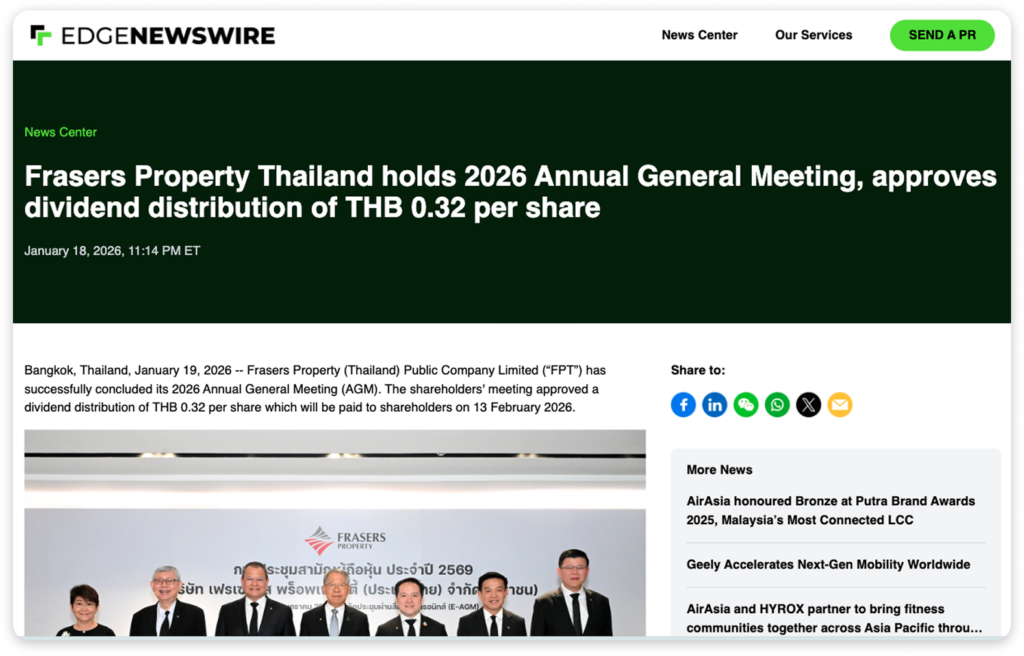
    Screenshot of an EdgeNewswire press release reporting Frasers Property Thailand’s 2026 Annual General Meeting and the approval of a dividend distribution of THB 0.32 per share.

    By presenting information in a way journalists and editors can quickly understand, a press release increases the chances of your news being picked up and reported.

    So who actually uses press releases?

    Who Uses Press Releases?

    Press releases are used by different groups, each for a specific reason. Understanding these roles helps explain why the format is structured the way it is.

    #1 Press Officers and Communications Teams

    Press officers use press releases to communicate official statements on behalf of an organization.

    Their responsibility is accuracy and clarity. When information needs to be shared publicly, a press release ensures that the details are correct, consistent, and documented.

    This is especially important during sensitive situations such as company changes, public issues, or crisis communication. 

    Example of company changes written in press release and published online:
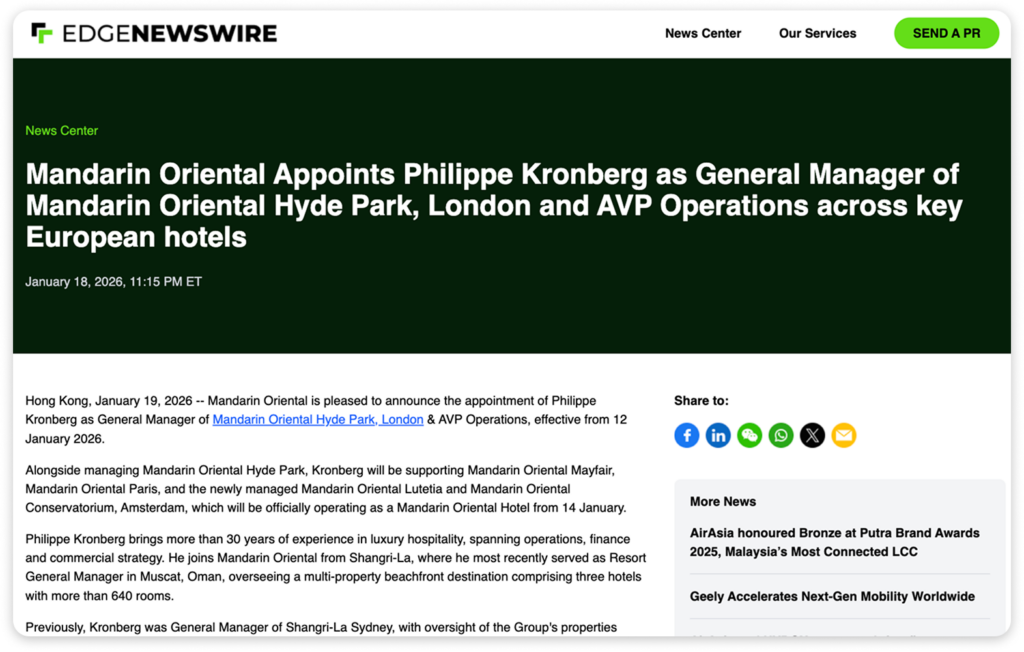
    Screenshot of EdgeNewswire article page showing a press release about Mandarin Oriental.

    A press release allows organizations to present one clear version of events rather than reacting to speculation.

    Over time, consistent press releases also help shape how an organization is perceived by the public.

    #2 Journalists and Editors

    Journalists use press releases as sources of information and story leads.

    They rely on press releases to quickly understand:

    • What happened
    • Who was involved
    • Why does it matter 

    A well-written press release includes names, dates, locations, quotes, and background context, which saves time during reporting.

    Many news articles begin with a press release and are later expanded through interviews or additional research. 

    #3 Businesses and Organizations

    Businesses use press releases to communicate with audiences beyond their existing customer base.

    Press releases allow companies to share updates without needing direct relationships with every journalist or publication. They help businesses appear active, transparent, and credible.

    They are commonly used to inform investors, partners, customers, and employees about developments that matter. 

    Press releases also help correct misinformation or clarify issues in a controlled way.

    Why Do Businesses Use Press Releases?

    Press releases provide several practical benefits when used correctly:
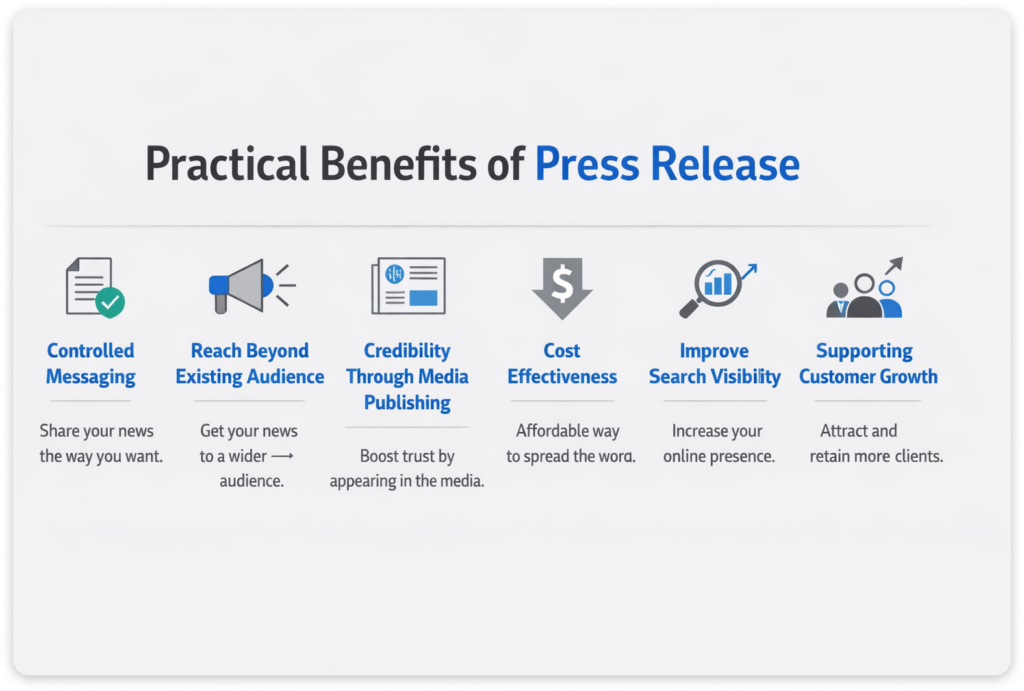
    Infographic outlining key benefits of using press releases for business communication.

    #1 Controlled Messaging

    A press release gives businesses control over what information is shared and how it is explained.

    Instead of relying on third-party interpretations, the business provides the original source of information. 

    This is especially important when accuracy matters, such as timelines, figures, or responsibilities.

    #2 Reach Beyond Existing Audiences

    Most businesses primarily communicate with people who already know them.

    Press releases help extend reach beyond websites, email lists, and social media followers. 

    When published by media outlets or news platforms, press releases reach readers who may not otherwise encounter the business.

    #3 Credibility Through Media Publishing

    Information published by media outlets is often perceived as more trustworthy than information published only on a company website.

    When a third-party platform publishes or references a press release, it adds credibility. 

    For instance, when you distribute a press release through EdgeNewswire, your news is made available to established media and information platforms such as Associated Press, Business Insider, Google News, USA Today, Ground News, Barchart, CapEdge, and hundreds of other media and financial sites.
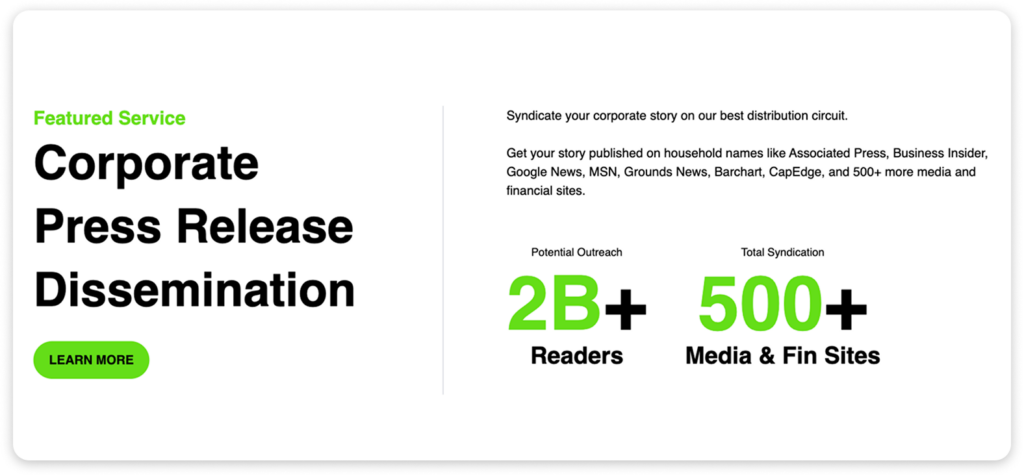
    Corporate press release dissemination service with media reach and syndication metrics.

    This means your announcement is no longer confined to your own platforms. It will have the chance to appear in places where journalists, investors, researchers, and the general public already look for news.

    #4 Cost Effectiveness

    Compared to traditional advertising, press releases are relatively cost-efficient.

    They do not require ongoing spend per click or impression. Once published, a press release remains available as a reference point. 

    This makes press releases a practical option for businesses with limited marketing budgets.

    #5 Improve Search Visibility

    Press releases published online can be indexed by search engines.

    When written clearly and structured properly, they can appear in search results for brand names, announcements, or related topics.

    Over time, this supports discoverability when people research a business.

    #6 Supporting Customer Growth

    Press releases help introduce businesses to new audiences.

    Announcements about launches, partnerships, or milestones can lead people to learn more about what the business offers. 

    While press releases are not sales messages, they support awareness and consideration.

    That brings us to an important question: what actually makes a good press release?

    What Makes a Good Press Release?

    A good press release is easy to read and easy to scan.

    Journalists often decide quickly whether something is relevant. Clear structure matters more than creative language.

    Headline

    The headline should clearly state the main news.
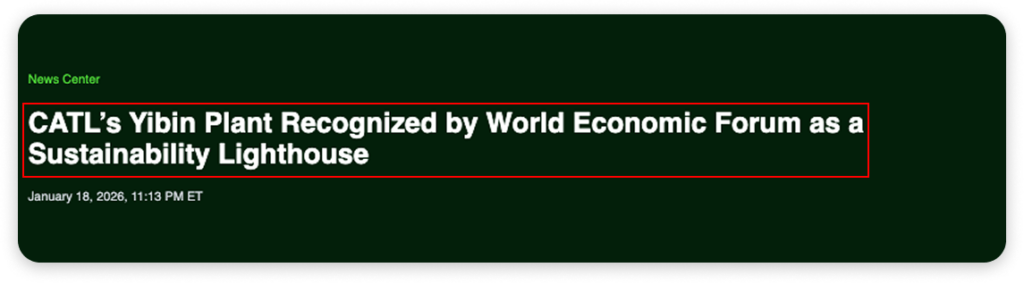
    Screenshot of an EdgeNewswire article headline, with a red box highlighting the text “CATL’s Yibin Plant Recognized by World Economic Forum as a Sustainability Lighthouse.”

    It should explain what happened without exaggeration. Someone should be able to understand the announcement by reading the headline alone.

    Summary

    The summary provides a short overview of the announcement.

    It helps readers quickly understand the main point before reading further.

    Dateline

    The dateline includes the city and date of release.
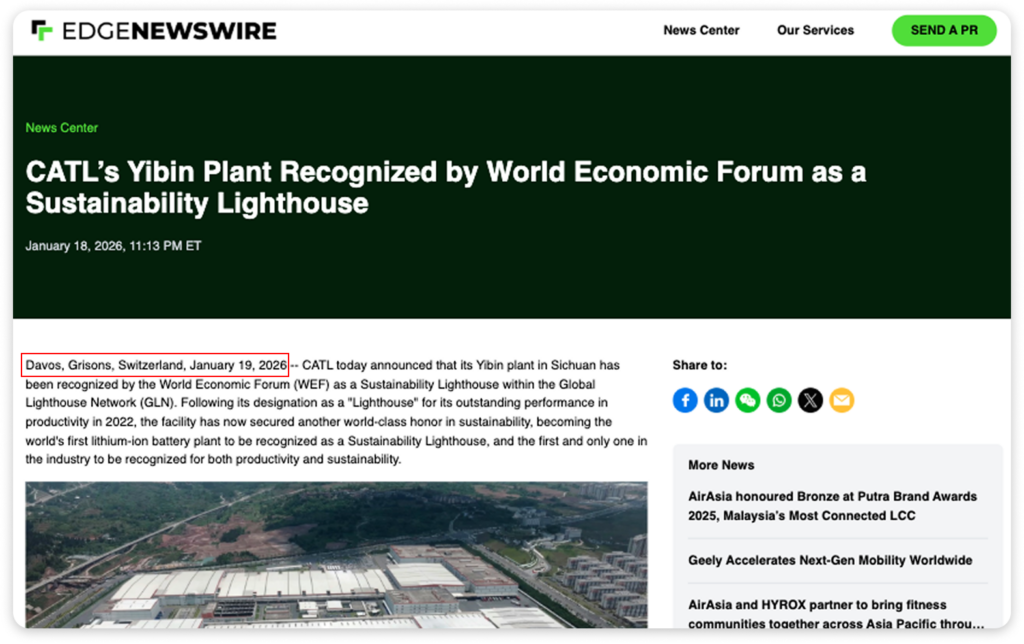
    Example of a press release lead paragraph highlighted on an EdgeNewswire article.

    This provides context and establishes when the news occurred.

    Opening Paragraph

    The opening paragraph should answer the key questions:

    • Who is involved
    • What happened
    • When it happened
    • Where it happened
    • Why it matters
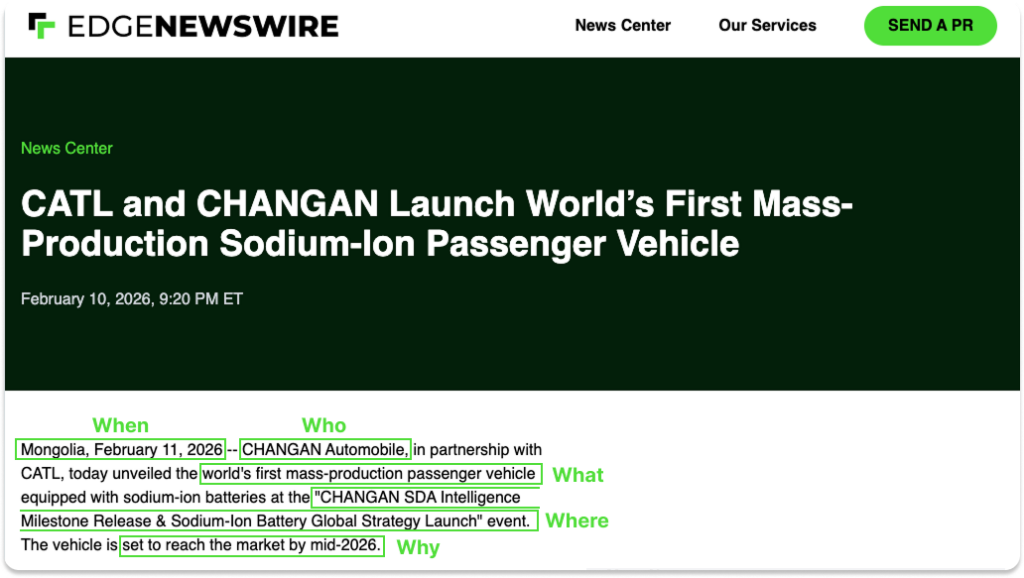
    Example of a press release body paragraph annotated to show the who, what, when, where, and why.

    This information should appear early, not later in the release.

    Supporting Details

    After the opening, the press release should provide additional context.

    This may include background information, explanations, statistics, or quotes from relevant people. Quotes should add insight or perspective rather than repeating facts.

    Boilerplate

    The boilerplate is a short description of the company.

    It explains what the company does in clear, factual language. This section should be consistent across press releases.

    Contact Information

    Clear contact details should always be included.
    Media contact details for Towngas listing Ms. Judy Chan, phone number, and email address.

    Journalists and editors need to know who to contact if they want clarification or follow-up information.

    How to Distribute a Press Release?

    Without proper distribution, a press release usually stays confined to a company’s own website or inbox. 

    That limits reach, credibility, and long-term visibility. Effective distribution places the announcement in environments where journalists, researchers, search engines, and AI systems already look for information. 

    In other words, distribution is what turns a press release from a document into a public signal.

    There are several common ways businesses distribute press releases, each serving a different purpose:

    #1 Emailing Journalists Directly

    Some businesses send press releases directly to journalists and editors.

    This method works best when the announcement is highly relevant to the journalist’s beat. It requires research and personalization and does not guarantee coverage.

    #2 Sharing on Social Media

    Press releases can be shared on platforms such as LinkedIn, X, or Facebook.

    Example of a company sharing its milestone on LinkedIn:
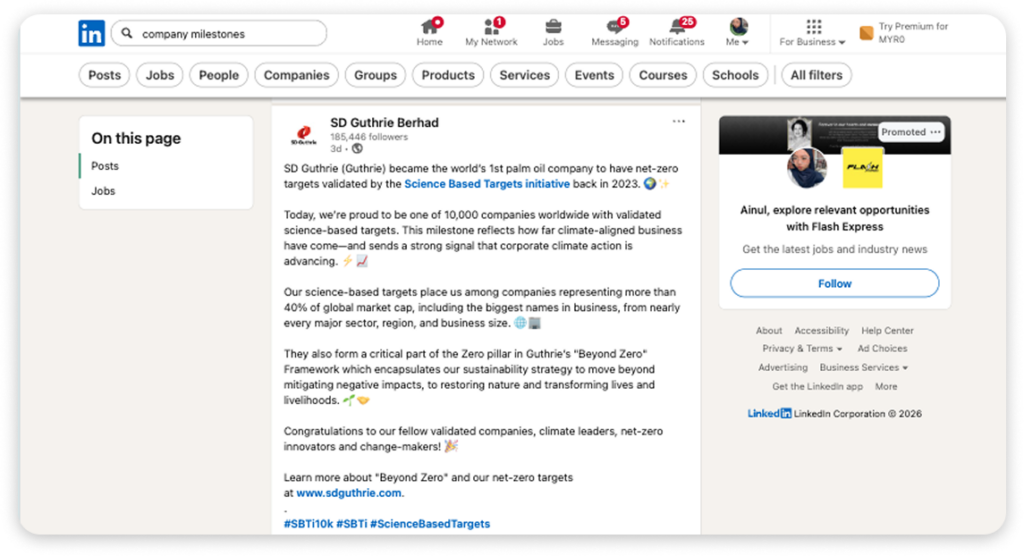
    Screenshot of a LinkedIn company post by SD Guthrie.

    Social sharing helps increase visibility but works best when paired with context explaining why the announcement matters. It should support, not replace, proper distribution.

    #3 Using Newswire Services

    Newswire services distribute press releases to a broad network of media outlets and news platforms.

    They simplify distribution by handling formatting, syndication, and reach. This approach is useful for businesses that want consistent visibility without managing individual media contacts.

    Platforms such as EdgeNewswire allow businesses to submit press releases and distribute them efficiently across multiple outlets.

    Final Takeaway

    Press releases are a practical way to make information public in a clear and structured format. 

    When written properly, they help ensure that announcements are understandable, traceable, and easy for others to reference over time.

    The effectiveness of a press release depends less on writing style and more on relevance and placement. 

    Clear facts, a standard structure, and appropriate distribution determine whether the information is noticed or overlooked.

    For businesses that want a straightforward way to publish and distribute press releases across established media and news platforms, EdgeNewswire offers a structured starting point.

    Frequently Asked Questions (FAQs)

    Q: How long should a press release be?

    A: A press release is typically between 400 to 800 words. It should be long enough to provide complete information but short enough to remain easy to scan. If it feels like it’s dragging, it usually is.

    Q: How often should a business publish press releases?

    A: There is no fixed frequency. Businesses should issue press releases only when there is something genuinely newsworthy. Publishing too often without meaningful updates can reduce credibility.

    Q: Can a press release be rejected by media outlets?

    A: Yes. Media outlets and journalists decide whether a press release is worth covering. If the content lacks relevance, clarity, or news value, it may be ignored or not picked up.

    Q: Do press releases need to include quotes?

    A: Quotes are not mandatory, but they are strongly recommended. A good quote adds context, perspective, or interpretation that goes beyond the basic facts.

    Q: Can small businesses compete with larger companies using press releases?

    A: Yes. Newsworthiness matters more than company size. A clear, relevant announcement from a small business can still be picked up if it is useful or interesting to the audience.
  • How to Write a Press Release for an Event

    How to Write a Press Release for an Event

    If you are running an event, you need a reliable way to let people know it exists and to help them decide whether it is worth their time. 

    A press release is one of the most straightforward ways to do that.

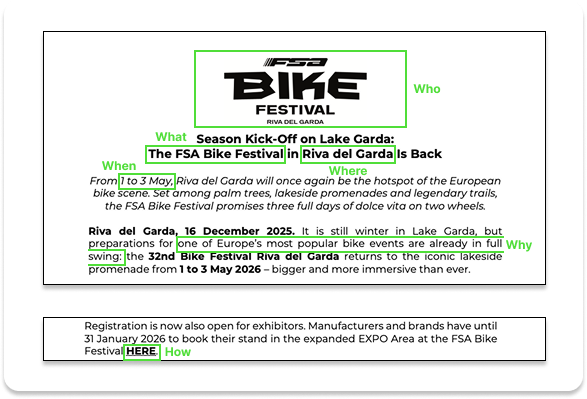
    An event press release is a structured announcement that covers the basics: 

    • Who is hosting
    • What is happening
    • When and where it takes place
    • Why it matters
    • How people can take part 

    For example:

    Annotated FSA Bike Festival press release highlighting who, what, when, where, why, and how.

    The goal of the press release is not to sound impressive. Instead, it is to make sure the information about the event is easy to understand and easy for the audience to act on once they read your press release.

    This is where event press releases differ from general announcements. 

    A normal press release often exists to document a change. An event press release has a more practical purpose. 

    It needs to help someone make a decision. Should I attend this? Should I share this? Should I care about this at all?

    To understand how to do that, it helps to start with a simple question: why do you need an event press release?

    Why You Need an Event Press Release

    You need an event press release because it gives your event a clear, credible way to reach people who are not already in your circle.

    More practically, it does a few important jobs:

    1. It helps people decide to attend

    The main purpose of an event is simple. You want people to show up.

    A good event press release puts the key details in one place and explains why the event is worth someone’s time. 

    Date, location, topic, and reason to attend should all be clear. If people have to guess, scroll, or search for basic information, many will not bother.

    The easier it is to understand what the event is and how to join, the more likely someone is to make a decision.

    Warning: Many weak event announcements fail here. They spend too much time talking about the organizer and not enough time explaining what actually happens at the event. Or they bury the registration link. Or they assume the reader already knows why the topic matters.

    2. It extends your reach beyond your own audience

    Your website, email list, and social channels mostly reach people who already know you. That is fine, but it has limits.

    Media coverage can put your event in front of people who would not otherwise hear about it. Even a small mention in a relevant publication can introduce your event to a new audience that already cares about the topic or industry..

    Over time, this also helps more people recognize your brand, not just this one event. But that is a side effect, not the main goal.

    3. It adds credibility

    A properly written press release signals that your event is organized and serious. It shows that you have thought through the details and are willing to put them in front of the public.

    That matters for attendees, but also for partners, sponsors, and speakers. 

    People are more comfortable associating themselves with something that looks clear and well put together.

    It also matters for journalists. Clear, well-structured information is easier to use. 

    If your release is confusing or sloppy, it creates extra work for them. Extra work is a good reason to skip your story.

    Types of Event Press Releases

    Not every event press release serves the same purpose. The timing changes what it is for.

    1. Pre-event press release

    This is the main announcement. It goes out before the event and focuses on awareness and interest.

    It should answer the basics and give people enough information to decide whether to attend and to plan for it. In most cases, this is the version you spend the most time on.

    The most common mistake here is waiting too long. If you send a pre-event release too close to the date, you limit who can realistically attend and how likely journalists are to cover it.

    Example of pre-event press release: 

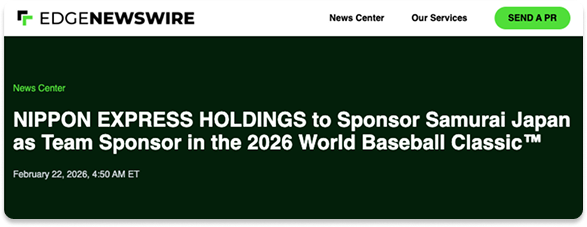
    Screenshot of an EDGENEWSWIRE press release announcing Nippon Express Holdings as a team sponsor for Samurai Japan in the 2026 World Baseball Classic.

    This is considered a pre-event press release because the 2026 World Baseball Classic has not taken place yet, and the announcement focuses on a sponsorship agreement made ahead of the tournament. 

    Its purpose is to build awareness and set context before the event begins by informing the public about Nippon Express Holdings’ involvement with Samurai Japan, rather than reporting on outcomes or recapping what has already happened.

    2. Day-of-event or live update press release

    This is used when timing matters. 

    For larger events, conferences, or public announcements, you may need to share last-minute updates, changes, or highlights as they happen.

    This is not always necessary. For many smaller events, it is overkill. But for time-sensitive or news-driven events, it can help keep coverage accurate and current.

    3. Post-event press release

    After the event, this version focuses on what happened such as:

    Infographic showing three items: Key Moments, Outcomes, and Takeaways, each with a simple icon.

    This helps extend the life of the event. 

    It creates a public record that you can reference later and gives you something concrete to point to when talking about results.

    It is also useful when the event itself is not the end goal, but part of a larger initiative.

    Each type serves a different purpose, but they all rely on the same fundamentals. The difference is in what you emphasize and when you send it. 

    That brings us to the practical part.

    Event Press Release Structure

    The structure is similar to a normal press release. The difference is in emphasis. For events, clarity and action matter more than anything else.

    1. Headline

    The headline should tell people what the event is and why it matters.

    Headline announcing Yotta, a new event by DatacenterDynamics focused on the future of digital infrastructure.

    Keep it short. Be specific. Avoid vague language. The goal is not to impress. Instead, the headline is to make the event clear at a glance.

    2. Summary

    This is the short version of the story. The usual practice is to use two or three sentences. It should answer the basics at a glance: what is happening, who it is for, and why it matters. 

    If someone only reads this part, they should still understand what the event is about.

    Think of the summary as the filter. A busy editor, journalist, or reader will often decide whether to keep reading based on these few lines. 

    If the summary is vague, overloaded with buzzwords, or focused on internal language, many people will stop right there. A clear, practical summary makes it easy for them to see why the event is relevant and worth their time.

    3. Dateline

    The dateline sets context. It tells the reader where the announcement is coming from and when.

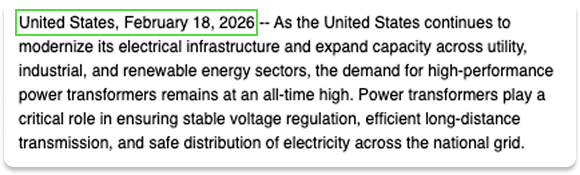
    Press release opening paragraph with a U.S. dateline discussing demand for high-performance power transformers and electrical infrastructure.

    This sounds minor, but it helps anchor the news in time and place, especially for events that are tied to a specific location.

    4. Body

    Start with the most important part of the event. Not your company history or background context. 

    You need to lead with what makes the event relevant.

    Then cover the details:

    • What kind of event it is, in-person, virtual, or hybrid
    • When and where it happens
    • Who should attend and why
    • What makes it useful or different
    • Any notable speakers or highlights
    • How to register or get more information

    Warning: This is where many releases become hard to use. They either dump too much information without structure, or they stay so vague that nothing is clear.

    The goal is to say the right things in a way that is easy to scan and understand.

    If you include quotes, they should add clarity or context. A quote that just repeats the headline in longer form does not help.

    5. Boilerplate

    This is the short “about the company” section. Three or four sentences is enough. Its job is to explain who you are and why you are relevant to the event. 

    About Transformers & Rectifiers (India) Ltd.” section describing the company as a global transformer solutions manufacturer.

    6. Contact information

    For this section, you need to include the details a journalist would use to reach you. 

    This section is necessary in case a journalist needs more information than what is in the release. 

    When that happens, they should be able to look here and immediately see who to contact and how to reach them.

    Include the contact person’s name, role, and clear contact details such as an email address or phone number, so follow-up is simple and fast.

    Press release contact information listing company name, email, and website for Transformers & Rectifiers (India) Limited.

    Guidelines for Writing Event Press Release

    1. Start with a real angle

    Every event has a reason to exist. 

    When you write about it, you should be able to point to something concrete, such as a timely topic, a specific audience, or a practical outcome. That is the angle.

    Leading with this matters because it explains why the event is relevant to people outside your organization. 

    If you cannot clearly show why this event matters now, it will be hard for anyone else to care or to cover it.

    2. Use clear, direct language

    You should use plain language to make sure the audience can understand the event at one glance. The goal is not to sound clever or impressive, but to be clear.

    This is important because journalists and readers often skim first. If a sentence is easy to misread or misunderstand, it probably will be, and that usually means the message gets lost.

    3. Avoid hype

    Overly promotional language makes your release harder to trust and harder to use. Journalists are trained to spot it and filter it out.

    To avoid that, stick to facts, context, and real reasons to attend the event. 

    This approach gives your release a much better chance of being taken seriously and actually used.

    4. Be specific about value

    In the press release, be clear about what someone will actually get from attending. The important details include:

    What will they learn? Who will they meet? What problem does the event help them solve?

    If you are vague about these important details, it becomes much harder for people to decide whether the event is worth their time.

    5. Use numbers if necessary

    If your event has 20 speakers, say so. Concrete details are easier to understand than general claims because they give people something real to picture and evaluate. 

    Saying “many speakers” or “an exciting lineup” does not tell the reader what they are actually getting. 

    Specific details help people decide whether the event is relevant to them and worth their time.

    6. Keep it easy to scan

    Short paragraphs and clear sections make your press release easier to read. Many people, especially editors and journalists, will skim first before deciding whether to read closely.

    A press release that is easy to scan helps them quickly find the key details they need. 

    If the structure is messy, important information gets missed and the story is more likely to be ignored.

    7. Proofread

    Mistakes in a press release will make you look unprofessional. They make you look careless and make journalists less likely to trust the details you are sharing. 

    If basic facts, names, or dates are wrong, it raises questions about what else might be wrong too.

    This is basic, but it is still one of the most common problems. 

    A release with errors is easier to ignore and harder to take seriously, especially when a journalist is deciding what to use under time pressure.

    Once you have worked through these guidelines, your press release should be clear and ready to use. 

    But good writing on its own is not enough. A well-written press release still needs proper distribution to have any real impact.

    If it does not reach the right journalists, publications, or audiences, it will not get read or used, no matter how good it is. 

    That is why distribution matters just as much as writing, and why the next step is to think carefully about how to get your event press release in front of the right people.

    How to Distribute Your Event Press Release

    There are several ways to get your press release out. You can publish it on your own site, send it directly to journalists, share it through partners, or use distribution platforms. 

    Each option has different trade-offs in terms of reach, control, time, and effort.

    The right approach depends on your goals, your audience, and how much time and resources you can realistically put into promotion. 

    What matters most is choosing the ones that actually help your release reach the people who are likely to care about your event.

    1. Publish it on your own site

    Publishing your press release on your own site gives you a stable reference point. 

    It creates a page you can link to, share, and point journalists or partners to. It also helps with search visibility over time, since the content is indexed and stays accessible.

    However, this is a passive step. 

    People still have to come to you to see it. Simply posting a press release on your site does not create attention on its own. 

    That is why this should be treated as infrastructure, not distribution. It supports your outreach, but it does not replace it.

    2. Share it through your own channels

    Social media and email are simple ways to spread the word about your event, especially to people who already follow you or are on your mailing list. 

    They are useful for making sure your existing audience knows what is happening and has an easy way to get the details.

    But, the limitation is reach. 

    Most of the time, these channels mainly circulate your message within your current network. That is helpful, but it does not do much to introduce your event to people who have never heard of you before.

    3. Send it to a focused media list

    You can also reach out directly to journalists who cover your industry or topic. 

    This takes more time than posting on your own channels, but it gives you more control over who sees the story and how it is positioned. 

    When done properly, this approach can lead to more relevant and higher-quality coverage.

    The key here is relevance. 

    A small, well-targeted list of journalists who actually cover your space usually works better than sending the same message to a large, generic list that includes people who are unlikely to care.

    4. Use a press release distribution service

    Distribution services exist to solve a simple problem: getting your press release in front of more outlets without doing everything manually. 

    They are not magic, but they are efficient, especially when you need scale, consistency, or speed. 

    Instead of emailing dozens of contacts one by one, you can rely on a system that already has distribution in place.

    For example, services like EdgeNewswire can distribute your press release to established media outlets such as USA Today, AP News, and Business Insider

    This will make your release easier to access for publishers and journalists who use those networks.

    These services are most useful when you want broader reach, predictable distribution, and reporting on where your release appears. 

    They do not replace good writing or a good story. They simply make the distribution part easier and more reliable.

    Final Takeaway

    Your event press release is competing with many others for attention. 

    The way to stand out is not by making bigger claims or using louder language. It is by being clearer, more useful, and better timed than the rest.

    Clear information helps people understand what the event is and why it matters. Good timing gives your release a better chance of being seen. 

    And good distribution makes sure it actually reaches the people who might care. Even a well-written release does very little if it never gets in front of the right audience.

    If someone can quickly understand the event, see why it is relevant, and know what to do next, your press release is doing its job. 

    The combination of clear writing and smart distribution is what makes that happen.

    Frequently Asked Questions (FAQs)

    Q: How far in advance should I send an event press release?

    A: There is no single perfect timeline, but most events benefit from being announced at least two to four weeks in advance. 

    This gives journalists time to plan coverage and gives potential attendees time to adjust their schedules. For larger events, conferences, or events that require travel, you may need even more lead time. Sending it too late limits both attendance and media interest.

    Q: Should I send more than one press release for the same event?

    A: In many cases, yes. A common approach is to send a pre-event release to announce the event, and a post-event release to summarize what happened. For larger or news-driven events, you might also send a short update closer to the date or on the day itself. The key is not to repeat the same message, but to update the angle and purpose each time.

    Q: Do I need a different press release for different audiences?

    A: Often, yes. The core facts stay the same, but what you emphasize can change. An industry publication may care more about the business or technical angle. 

    A local outlet may care more about location and community impact. Adjusting the framing makes your release more relevant without changing the underlying information.

    Q: Can I reuse the same event press release every year?

    A: You can reuse the structure, but not the content. Journalists and readers want to know what is new or different this time. Dates, speakers, topics, and outcomes should be updated. If the release looks like last year’s with a few numbers changed, it is much easier to ignore.

    Q: Is it better to attach the press release or paste it into the email?

    A: In most cases, pasting the press release into the email works better. Many journalists prefer not to open attachments unless necessary. Keeping everything visible in the email makes it easier for them to quickly scan and decide whether the story is relevant.

  • What is Media Relations and Why is it Important?

    What is Media Relations and Why is it Important?

    Most organizations want media coverage because it gives them credibility they cannot buy.

    When a publication covers your company, nonprofit, or project, it changes how people see you. It will create that moment where readers think, “Oh, this company is legit! Independent outlets are talking about it.”

    Media coverage also puts you in front of relevant audiences because journalists build their readership around specific beats like business, tech, healthcare, or local news. When your story appears in the right place, you are more likely to reach people who are already in your target market.

    That raises two questions: what does media relations actually involve, and why is it worth the effort?

    What is Media Relations? 

    Media relations is the practice of working with journalists and editors so your news has a chance to be covered as editorial content. 

    It’s earned media, not paid advertising or sponsored posts.

    In practice, media relations usually includes:

    • Writing press releases and background materials
    • Pitching specific story angles to relevant journalists
    • Answering follow-up questions and providing context or data
    • Coordinating interviews or briefings
    • Supplying images, facts, or supporting documents

    Over time, this work builds a track record. Journalists learn which sources are reliable and which ones waste their time. That reputation matters more than most teams expect.

    Why is Media Relations Important?

    The value of media relations shows up in a few very practical ways.

    #1 It builds credibility

    When an independent outlet like USA Today, Business Insider, and AP News covers your story, it carries more weight than something you publish yourself. 

    Readers understand the difference between marketing copy and editorial judgment, even if they cannot always explain it.

    #2 It reaches the right people

    Journalists already have audiences.

    If your story appears in a publication that covers your space, you reach people who are more likely to care about the topic in the first place.

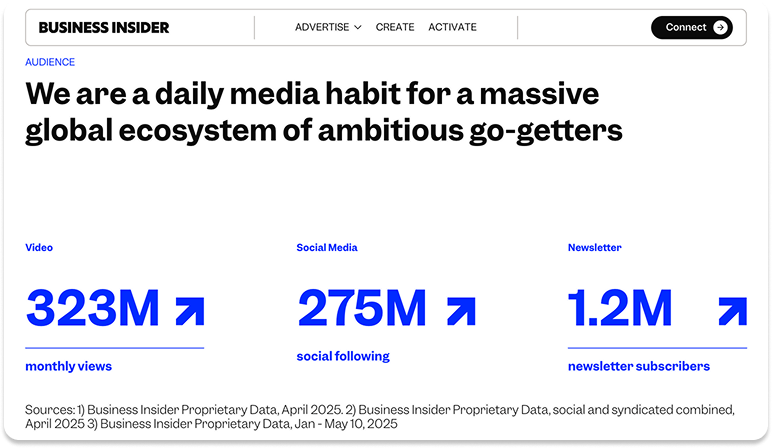
    For example, outlets like Business Insider have large, business-focused audiences:

    Business Insider audience page showing 323M monthly views, 275M social followers, and 1.2M newsletter subscribers.

    Once your release appears in a publication like Business Insider, you have a better chance of being discovered by people who already follow that space.

    #3 It keeps working over time

    Once your releases are published, they stay online and searchable. 

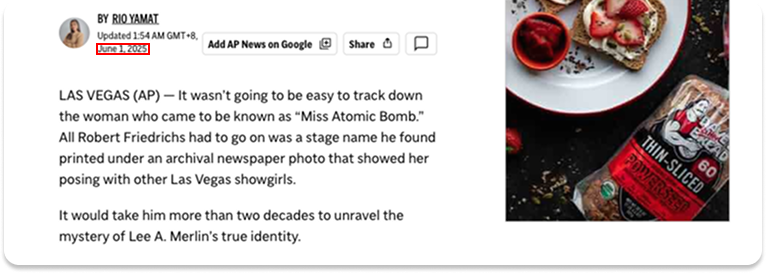
    For example, when AP News wrote about ‘Miss Atomic Bomb’ in June 2025, that article did not vanish even after 4 months.

    AP News article page with a story excerpt and an image of food on the right.

    It is still there, still searchable, and still discoverable by anyone looking up about it.

    #4 It delivers measurable ROI

    Media coverage works differently than paid advertising. Instead of paying for every impression, you invest in creating newsworthy content and distributing it professionally. One solid piece of coverage (especially from an industry-specific publication) can generate more qualified leads than thousands of dollars in ad spend.

    For B2B companies and niche markets where relevant audiences are expensive to reach through paid channels, this efficiency advantage is substantial.

    What You Actually Do in Media Relations

    1. Building and maintaining a media list

    A good media list is focused and current. It includes journalists who actually cover your topic.

    The reason is simple. Journalists work on specific niches. If you send a story about factory automation to someone who covers lifestyle or politics, it will be ignored. 

    A smaller, well-targeted list almost always outperforms a large, generic one.

    2. Deciding what is worth pitching

    It is important to know what is actually worth pitching, otherwise you end up wasting time on stories no one wants to cover. 

    Not every internal update is news. 

    A simple test can help you to decide: would someone outside your company care about this if your logo were removed from the story? If the answer is no, it probably needs a different angle or more substance.

    3. Preparing spokespeople

    A spokesperson is the person who represents your organization when talking to the media. This role matters because journalists will often rely on that person’s words to shape the entire story. 

    If they are unclear, careless, or overly promotional, it shows up in the coverage.

    For that reason, you need to prepare your spokespeople that can explain things clearly and correctly, instead of persuading. 

    They should know what they can say, what they should avoid, and how to communicate in plain language without turning answers into a pitch.

    Otherwise, you can end up in the kind of situation where an executive’s response becomes the headline and extends the controversy instead of calming it.

    A well-known example is the United Airlines incident, where Oscar Munoz, then CEO of United, made early statements that focused on defending internal procedures and blaming the passenger. 

    Article headline reading “United Airlines CEO: Passenger Removed From Flight Was ‘Disruptive and Belligerent"

    Even if some details were accurate, the tone came across as defensive and out of touch with what people had seen in the videos, which made the backlash worse, not better.

    4. Creating usable materials

    Press releases, fact sheets, backgrounders, and images exist to make a journalist’s job easier. So you need to prepare good materials for them. 

    If a journalist cannot quickly find the key details they need, they are less likely to use your story.

    In practice, “basic information” usually means things like:

    • What is the news?
    • Who is involved?
    • When did it happen?
    • Why does it matter?
    • How does it work?
    • Who can I contact for follow-up?
    • Where are the images or supporting materials?

    Journalists work under time pressure. If they open your release or media kit and have to hunt for these answers, they may just move on to the next story.

    5. Pitching stories

    A pitch should be short and specific. It should explain why the story fits that reporter and why it matters now. 

    For that reason, you should avoid sending the same message to every journalist on your list. 

    A targeted pitch shows that you understand the reporter’s work and that you are offering something relevant, not just broadcasting an announcement and hoping someone picks it up.

    6. Coordinating interviews and briefings

    Some stories need more input from the people involved. To make that happen, you need to coordinate scheduling, preparation, and follow-up so you can get the right people involved. 

    Those people can then provide the accurate and useful information the journalist needs.

    7. Tracking coverage

    You should know what gets published, where, and how it is framed. This is important to help your organization understand what is actually working and what is not. 

    Looking at the coverage shows you which stories resonate, which angles fall flat, and where your messaging gets misunderstood or ignored. 

    Without this feedback, you are just guessing and likely to repeat the same mistakes.

    8. Maintaining relationships

    This mostly comes down to being useful, honest, and responsive. 

    Journalists remember who wastes their time. They also remember who makes their work easier.

    These mechanics of media relations are necessary, but they are not the whole picture. Without a clear strategy, even good execution turns into scattered effort. 

    The next step is to look at how to shape these activities into a coherent media relations strategy.

    Best Practices for Effective Media Relations

    Without a clear strategy, media relations often fail, even when the tools are in place. That is why strategy is one of the most important parts of doing media relations well.

    #1 Start with relevance

    Define who you want to reach and where they get information. Build your media list around that.

    Do not start with outlet rankings or logo collections.

    #2 Set simple goals

    You need goals because they give your media relations work direction. Without them, it is hard to decide what to pitch, who to pitch to, or whether your effort is paying off.

    But the goals also need to be the right kind. 

    For instance, “More coverage” is not very useful because it is vague and hard to measure. It does not tell you which outlets matter or what kind of stories you should focus on. 

    A simple goal like “coverage in these three industry publications around this topic” is clearer and easier to evaluate. If you cannot tell whether you succeeded, you cannot learn or improve.

    #3 Plan your story pipeline

    Looking ahead helps you avoid treating every announcement as a last-minute scramble. Product updates, data releases, customer stories, and industry commentary usually do not come out of nowhere. 

    If you plan them in advance, you have time to shape better angles, gather useful details, and line up the right spokespeople.

    When everything is done at the last minute, most stories end up sounding generic. They focus on what happened, but not why it matters, and they are much harder for journalists to use.

    #4 Focus on stories

    “Company does X” is rarely enough on its own. That is just a statement of fact, and it gives a journalist very little to work with. 

    What makes something worth covering is usually context, timing, or impact.

    “Here is why X matters now” works better because it explains why the news is relevant to people outside your company. 

    It gives the story a reason to exist today and makes it more useful to a reader, not just to you.

    #5 Be realistic about timing

    Major news events, industry conferences, and reporting schedules all affect what gets covered.

    You cannot control those things, but you can avoid launching your story when everyone is focused on something bigger and more urgent.

    #6 Review outcomes

    It is easy to confuse activity with results. Sending ten pitches only tells you that work was done. It does not tell you whether the work was effective. 

    Outcomes are things like getting a reply, having a meaningful conversation with a journalist, or securing a piece of coverage. 

    Reviewing these outcomes helps you see what is working, what is not, and where you need to adjust your approach.

    Even with a simple strategy like this, many teams still struggle with media relations. Most problems do not come from a lack of tools or effort. They come from repeating a small set of common mistakes.

    Common Mistakes in Media Relations

    Some patterns show up again and again.

    • Spray and pray: Sending the same pitch to everyone on your media list shows you haven’t done the work to understand what each journalist actually covers. Targeted pitches get responses. Generic blasts get ignored.
    • Treating updates as news: Minor feature releases, small client wins, or internal promotions usually aren’t newsworthy on their own. They need bigger context or a compelling angle to matter to people outside your company.
    • Overloading press releases: Trying to announce three different things in one release dilutes all of them. Pick the most newsworthy angle and lead with that.
    • Chasing logos over relevance: Coverage in TechCrunch sounds impressive, but if your target market doesn’t read TechCrunch, it’s not helping you. Focus on outlets your audience actually follows.

    These mistakes share a common root: confusing visibility with value. More pitches, bigger outlets, and wider distribution don’t matter if the underlying story isn’t relevant to the journalists you’re pitching or the audiences you need to reach.

    Final Takeaway

    Effective media relations is about having something worth covering, sending it to the right people, and making it easy for your story to be understood and picked up.

    Press releases and distribution platforms like EdgeNewswire play a key role in making that happen. 

    They help you scale your reach, increase visibility, and put your news in front of the audiences and outlets that matter. 

    When paired with a clear story and smart positioning, distribution becomes a powerful way to amplify your message, not just a delivery mechanism.

    The strongest results come from combining relevance, relationships, and reach. When those work together, you give your story the best chance to earn coverage that actually makes an impact.

    Frequently Asked Questions (FAQs)

    Q: What is media relations?

    A: Media relations is working with journalists to earn editorial coverage. It includes press releases, pitching stories, arranging interviews, and providing supporting materials.

    Q: How is media relations different from advertising?

    A: Media relations earns unpaid editorial coverage, while advertising is paid placement. Editorial coverage tends to carry more credibility because it’s independently chosen.

    Q: How do I know if a story is worth pitching?

    A: Remove your logo and ask if an outsider would care. If not, the story likely needs a stronger angle or more substance.

    Q: What are the most common mistakes in media relations?

    A: Common mistakes include mass pitching, treating minor updates as news, cramming multiple announcements into one release, and targeting big outlets instead of relevant ones.

    Q: How should I build a media list?

    A: Keep it focused and up to date, targeting journalists in your niche. A smaller, relevant list usually performs better than a broad one.

  • What Is a Publicity Stunt and How Brands Use It Effectively

    What Is a Publicity Stunt and How Brands Use It Effectively

    Most businesses face the same challenge: getting noticed without wasting budget.

    Advertising is expensive, organic reach is limited, and competing for attention online is harder than ever. 

    That’s why some brands turn to publicity stunts. When done right, a single moment can generate more attention than weeks of planned marketing.

    But publicity stunts are not about being loud for the sake of it. They are a deliberate tactic used to create fast visibility, spark conversation, and earn media coverage that businesses cannot easily buy through ads.

    To understand whether this approach makes sense for a business, it helps to first understand what a publicity stunt actually is and how it works.

    What Is a Publicity Stunt?

    A publicity stunt is a planned action designed to attract attention in a short period of time. Its primary purpose is visibility, not long-term engagement or direct sales.

    Unlike traditional marketing campaigns that run over weeks or months, publicity stunts are built around a single moment.

    They rely on surprise, scale, or novelty to prompt people to notice, talk about, and share the brand.

    Publicity stunts often take forms such as:

    • A random overnight session at the brand’s store
    • A brand collaborating with a celebrity for a one-off, highly visible stunt
    • An unexpected window break during the live demo

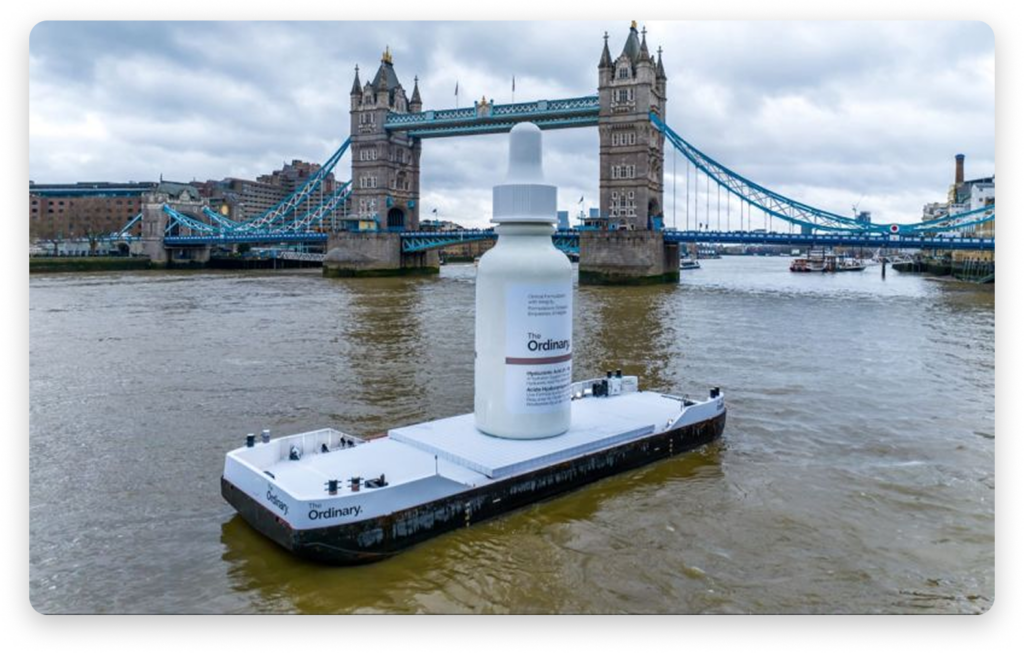
    Take The Ordinary’s floating skincare bottle stunt. The brand placed a massive replica of their cult-favorite product on a boat in the River Thames, right next to Tower Bridge.

    Large replica The Ordinary skincare bottle displayed on a floating platform in the River Thames near Tower Bridge as part of a brand publicity stunt.

    As a result, the brand and its product become widely discussed across media outlets and social platforms. That’s a successful publicity stunt.

    Why Do Brands Use Publicity Stunt?

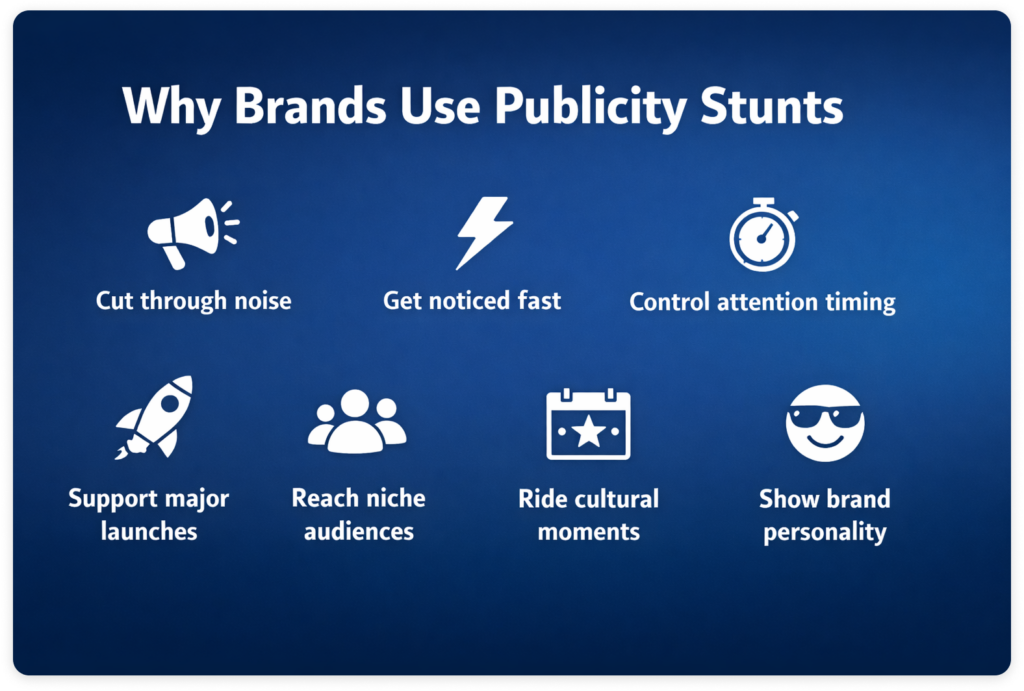
    Graphic titled “Why Brands Use Publicity Stunts” showing seven reasons with icons.

    #1 Cut through noise

    Most marketing messages look similar and compete for the same limited attention. Publicity stunts work because they interrupt that pattern. 

    Instead of blending in with ads or announcements, a stunt creates something unexpected that people pause to notice.

    #2 Get noticed fast

    Publicity stunts are often used when brands need attention immediately.

    • Product launches
    • Major announcements
    • Competitive responses

    Rather than building awareness over weeks, a single moment can generate discussion within days.

    #3 Control attention timing

    Stunts allow brands to decide when attention happens. 

    Instead of spreading messages across channels and hoping they gain traction, attention is concentrated into a specific moment.

    How Apple used dramatic outdoor ads for the surprise reveal of AirPods Pro is a strong example.

    By concentrating all communication into a single moment, the brand was able to dominate both media coverage and public attention for the entire day.

    Apple rolled out towering images of dancers for the AirPods Pro launch.

    #4 Support major launches

    Publicity stunts are rarely the full strategy. They are often used to amplify a larger campaign.

    A stunt creates curiosity and visibility, making audiences more receptive to the detailed messaging that follows. 

    #5 Reach niche audiences

    Not every stunt is designed for mass appeal. Some are built to resonate with a specific group first.

    When The Ordinary floated that giant product, skincare enthusiasts went wild. That focused energy then rippled outward to mainstream media.

    That focused interest helped the moment spread outward to wider media.

    #6 Ride cultural moments

    Brands sometimes design stunts around events, holidays, or trends people are already paying attention to. 

    This reduces the effort needed to get noticed because the audience is already engaged elsewhere.

    When timed well, the stunt feels relevant rather than intrusive.

    #7 Show brand personality

    A publicity stunt can communicate how a brand wants to be perceived without long explanations.

    Want to show you’re bold? Pull a bold stunt. Want to seem playful? Create something fun and unexpected.

    The action becomes the message—no lengthy brand storytelling required. People understand who you are by what you do.

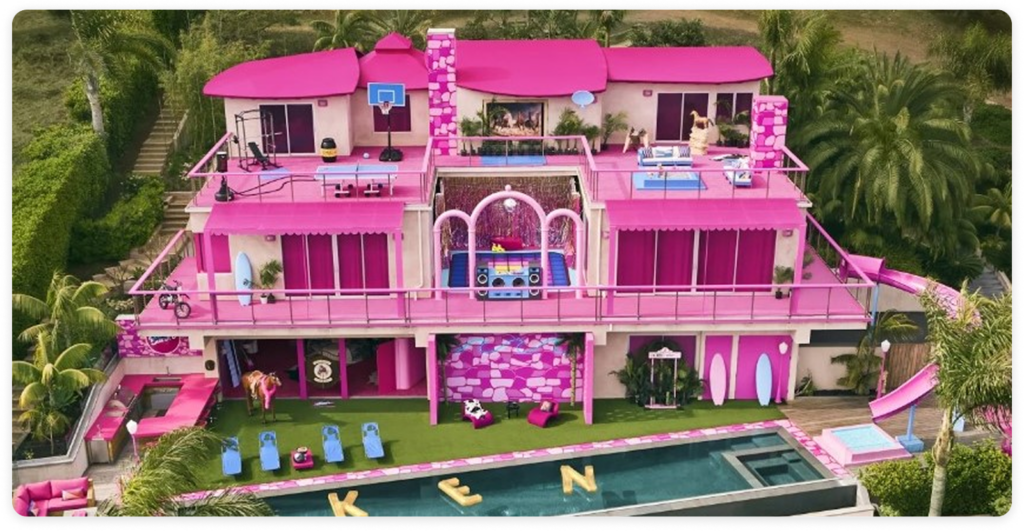
    A good example is Barbie’s Malibu Dreamhouse activation. In the lead-up to the Barbie movie release, the iconic Dreamhouse appeared in Malibu and was listed on Airbnb for a free one-night stay. 

    Guests were “hosted” by Ken while Barbie was said to be away for the summer. The oversized pink house, complete with a pool and ocean views, leaned fully into Barbie’s playful, exaggerated identity.

    The stunt arrived at the peak of cultural interest around the film and extended into collaborations across fashion, gaming, and lifestyle brands, led by Mattel. It did not explain what Barbie stands for. It showed it.

    A bright pink Barbie Dreamhouse in Malibu with multiple levels.

    But not every PR stunt that gets attention delivers value. Some create lasting impact, others disappear as quickly as they appear.

    The outcome depends on a few core factors that determine whether a stunt resonates or is forgotten.

    What Makes a Successful PR Stunt?

    Successful PR stunts share a few common traits:

    #1 Clear relevance beyond the brand

    A successful PR stunt works when people care about the idea even if the brand name is removed. 

    In other words, people should care about what is happening, not just who is behind it. When a stunt is built only around promoting a product or logo, it often feels like advertising and is easy to ignore. 

    When it is built around an idea that already matters to the audience, such as human achievement, social values, or shared curiosity, the attention comes naturally. 

    The brand benefits because it is associated with the idea, not because it is forcing a sales message.

    #2 Strong connection to existing audience interests

    A strong PR stunt connects with what the audience already likes, follows, or talks about. 

    It does not ask people to change their habits or figure out something unfamiliar just to understand the message. 

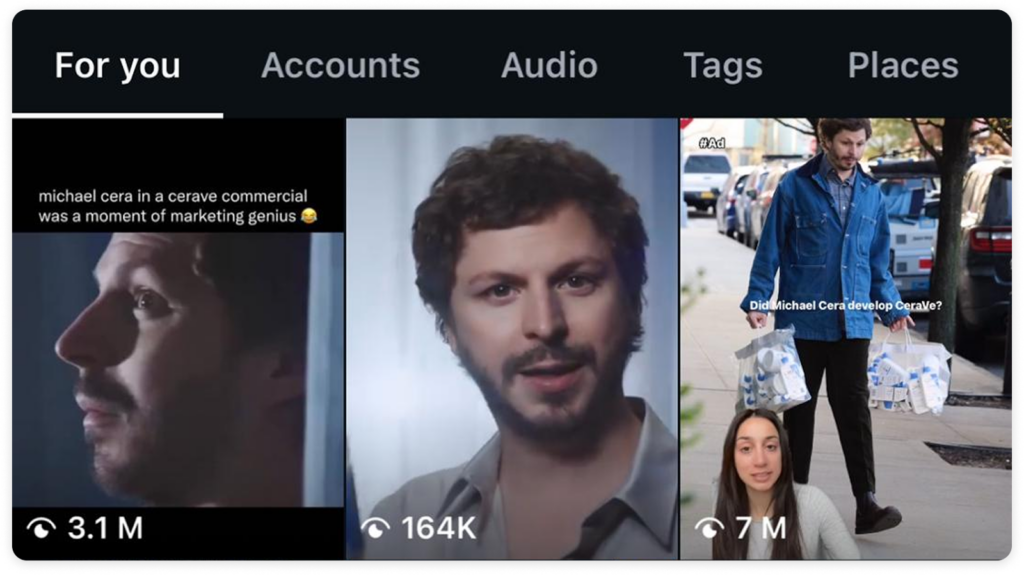
    Instead, it fits naturally into existing interests, platforms, and behaviors. A good example is how CeraVe leaned into internet humor with Michael Cera. The original video itself drew a large number of views and quickly became a talking point on Instagram and other social platforms.

    What made it effective was not just the reach, but the reaction. People discussed it, questioned it, joked about it, and shared it organically. The conversation extended beyond the brand’s own post, with creators and users referencing the video in their own content.

    A social media discovery feed showing multiple videos about Michael Cera and CeraVe.

    When a stunt matches how an audience already spends their time, it feels easy to engage with. People understand it quickly, are more likely to share it, and are more willing to talk about it. 

    In contrast, a stunt that ignores audience interests or asks for too much effort often feels forced and is easier to ignore.

    This is why successful stunts often appear in places and formats the audience already uses, such as social media conversations, trending topics, or familiar cultural references. 

    #3 Timely execution

    Timing matters because people do not pay attention to everything all the time. 

    A PR stunt is more likely to work when it happens at a moment when the audience is already alert, interested, or emotionally engaged. 

    If a stunt is launched when attention is elsewhere, even a strong idea can be overlooked.

    Good timing can come from creating a moment or joining one that already exists. 

    Some stunts work because they introduce something new at exactly the right time. Others work because they connect to ongoing conversations, events, or cultural moments people are already talking about. 

    When the timing is right, the stunt feels relevant and easy to engage with. When the timing is wrong, it can feel out of place, insensitive, or simply ignored.

    In short, timing determines whether a stunt feels timely and relevant, or late and disconnected.

    #4 A story that can be explained in one sentence

    Journalists need to understand and explain a stunt quickly. 

    Why? Because for a PR stunt to gain coverage, reporters need to understand what happened and why it matters almost immediately. 

    If a stunt requires long explanations, background context, or multiple clarifications, it becomes harder to cover and easier to skip.

    Successful stunts can be summarized in a single sentence. 

    This makes them easy for journalists to report, headline, and share with their audiences. When the idea is simple and clear, media coverage focuses on the stunt itself rather than trying to explain it. 

    If the story is confusing, the stunt loses momentum and attention moves on quickly.

    Examples of Successful Publicity Stunts

    Let’s look at real examples of publicity stunts that generated the attention their creators wanted and delivered measurable business results. Each of these stunts succeeded for specific, identifiable reasons.

    Example 1: Red Bull Stratos (A Product-Led Publicity) 

    In 2012, Red Bull sponsored Austrian skydiver Felix Baumgartner’s jump from the edge of space, 24 miles above Earth. 

    The event was broadcast live on YouTube and required years of planning, scientific collaboration, and significant investment. 

    Baumgartner broke the sound barrier during his free fall, setting multiple world records.

    <video>

    This event attracted media coverage not because Red Bull did it, but because it represented a historic moment in human achievement. News outlets covered it as a scientific story, not an advertising story.

    The live broadcast drew 8 million simultaneous viewers on YouTube, setting a record at the time. The event generated an estimated $6 billion in media value, with coverage spanning news outlets, sports media, and scientific publications.

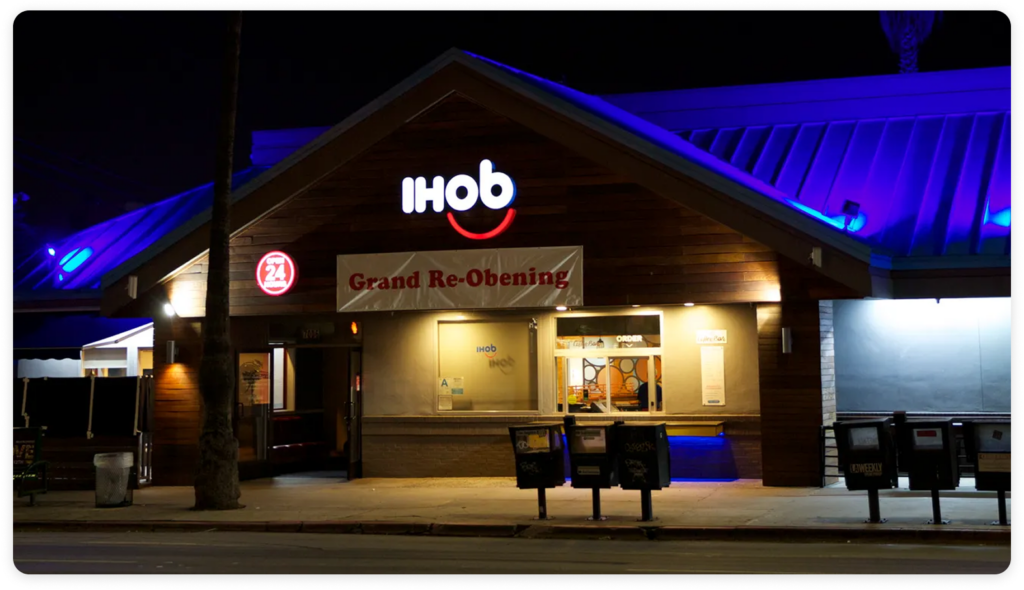
    Example 2: IHOP Becomes IHOb (A Cultural Moment Stunt)

    In 2018, IHOP (International House of Pancakes) temporarily changed its name to IHOb, announcing the change on social media without immediately revealing what the “b” stood for. 

    Exterior of an IHOb restaurant at night with illuminated signage and a banner reading “Grand Re-Opening” above the entrance.

    The mystery generated intense speculation across social media for several days before the company revealed that “b” stood for burgers.

    The stunt was a success because it created a puzzle that people wanted to solve. The timing aligned with the social media era’s love of speculation and viral mystery. 

    The temporary name change was simple enough to grasp in seconds but intriguing enough to prompt discussion.

    The campaign generated 36 billion media impressions and drove a fourfold increase in burger sales. 

    Competitors like Burger King and Wendy’s joined the conversation, creating additional free publicity as the story expanded beyond IHOP’s initial announcement.

    Example 3: Patagonia’s “Don’t Buy This Jacket” (An Industry-Specific Stunt)

    On Black Friday 2011, outdoor clothing company Patagonia ran a full-page ad in The New York Times with the headline “Don’t Buy This Jacket.”

    An ad with the headline "Don't Buy This Jacket."

    The ad explained the environmental cost of producing one of their jackets and urged consumers to think carefully before making unnecessary purchases.

    The stunt was counterintuitive. Most brands use Black Friday to drive sales, but Patagonia used it to challenge consumerism. 

    This contradiction created a newsworthy story because it went against expected behavior. Media outlets covered it not because Patagonia spent money on an ad, but because the message was unexpected and provocative.

    The campaign aligned perfectly with Patagonia’s existing brand values around environmental sustainability. 

    It didn’t feel like a gimmick because the company had a long history of prioritizing environmental responsibility over profit maximization. 

    The stunt reinforced existing brand identity rather than contradicting it.

    But, not every publicity stunt succeeds. Some generate attention but damage the brand. Others simply fall flat, wasting budget and failing to achieve any meaningful impact.

    Examples of Failed Publicity Stunts

    Understanding why stunts fail is as important as understanding why they succeed.

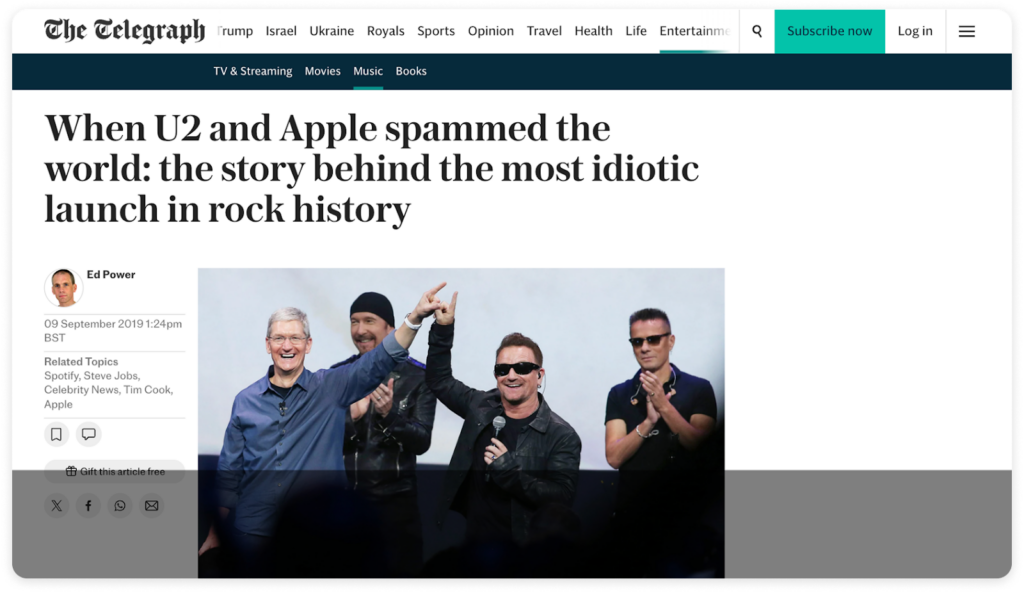
    Example 4: U2’s Forced Album Download (Attention Without Relevance)

    In 2014, Apple partnered with U2 to promote the band’s new album Songs of Innocence by automatically adding it to the music libraries of roughly 500 million iTunes users. 

    The album appeared on users’ devices without permission, and many people found it difficult to remove.

    The stunt immediately drew massive attention because nearly every iTunes user was affected. 

    However, the reaction was largely negative. Many users felt their personal space had been violated by having content forced onto their devices, even if it was free.

    A screenshot of a Telegraph article titled “When U2 and Apple spammed the world.

    Instead of focusing on the album itself, media coverage centered on user frustration and Apple’s decision-making. Headlines highlighted backlash and complaints, not the music or the partnership. 

    The stunt became the story, and the intended message was lost.

    While the campaign achieved enormous reach, it lacked relevance and consent. Exposure at this scale created annoyance rather than goodwill. 

    The core mistake was assuming that more exposure automatically equals success. The stunt prioritized visibility over user choice, ignoring how people would actually experience it.

    The situation worsened due to the initial response from Apple and U2. 

    Both appeared surprised by the backlash, which made the move seem tone-deaf. This reinforced the perception that the brands were disconnected from their audience.

    Example 5: Pepsi’s Kendall Jenner Ad (Poor Timing and Misjudged Audience)

    In 2017, Pepsi released an ad featuring Kendall Jenner leaving a photoshoot to join a street protest. 

    The ad ends with Jenner handing a Pepsi to a police officer, after which the tension disappears and the crowd celebrates.

    The ad launched while real protests over police violence and social justice were happening across the United States. In that context, the message felt disconnected from reality. 

    It suggested that serious social conflict could be resolved through a symbolic, feel-good gesture, which many viewers found dismissive and inappropriate.

    The backlash was immediate. 

    Critics accused Pepsi of trivializing social movements and using them as a marketing backdrop. 

    Within 24 hours, the company pulled the ad and issued an apology. Coverage focused on the misjudgment, not the brand message.

    The core failure was a lack of authenticity and clarity. The ad tried to acknowledge social activism without taking a real position, aiming to appeal to everyone at once. That approach satisfied no one.

    The takeaway is straightforward. When brands reference social issues without understanding their context or weight, attention turns into backlash rather than goodwill.

    Not all attention is positive. This is why the impact of a publicity stunt must be measured beyond reach and impressions.

    How to Measure the Impact of a Publicity Stunt

    Measuring a publicity stunt starts with understanding its purpose. 

    A stunt is not meant to do everything. It is usually designed to create attention, shape perception, or support a larger business objective. The metrics you track should reflect that.

    #1 Media coverage quality

    Count how many outlets covered the stunt, but pay more attention to where it was covered and how it was framed.

    • Was the coverage in relevant, credible publications?
    • Did headlines focus on the intended message, or on controversy and confusion?
    • Was the brand positioned positively, neutrally, or negatively?
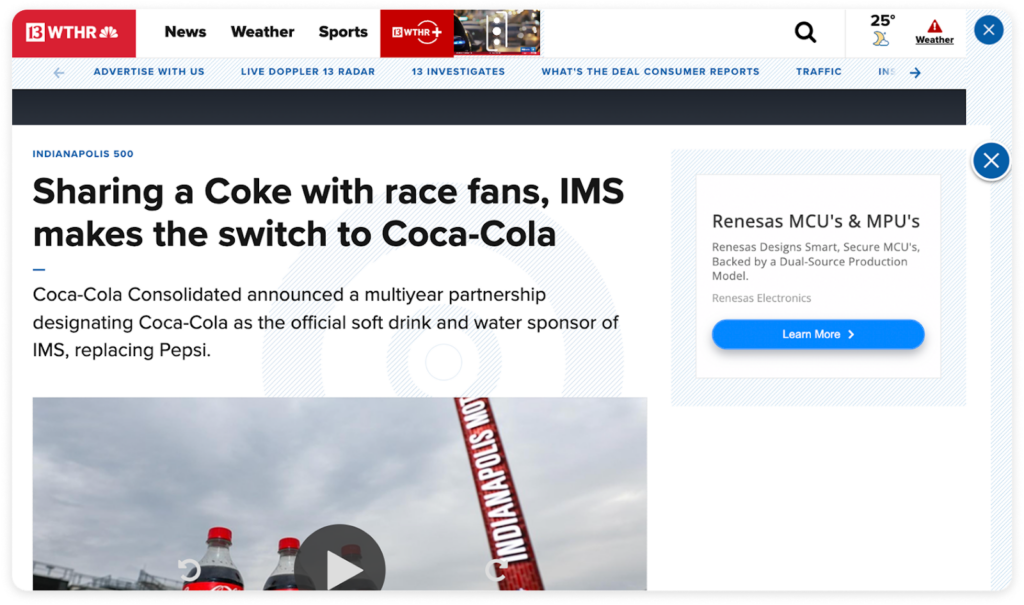
    A screenshot of a WTHR 13 news article titled “Sharing a Coke with race fans, IMS makes the switch to Coca-Cola."
    Positive local media coverage following Coca-Cola’s experiential activation at the Indianapolis Motor Speedway, highlighting how the brand connected with race fans through a visible, on-site partnership rather than a traditional announcement.

    A stunt that generates fewer but relevant and accurate stories is more valuable than one that creates widespread but unfocused coverage.

    #2 Audience response and sentiment

    A publicity stunt can be widely seen and still fail if the reaction damages trust or weakens the brand. 

    What is important is how people respond to the stunt and what they say about it after the initial exposure.

    To evaluate this, look at questions such as:

    • Are people discussing the stunt positively, critically, or dismissively?
    • Are conversations aligned with the message the brand intended to communicate?
    • Did the stunt spark genuine discussion or just short-lived reactions?

    Sentiment analysis across social platforms and comments helps distinguish interest from backlash.

    #3 Engagement beyond initial exposure

    Look at what people did after they noticed the stunt. 

    Initial attention only has value if it leads to further action. Engagement shows whether the stunt held interest beyond the first impression.

    Signs of meaningful engagement include people sharing the stunt, commenting on it, or discussing it in detail. 

    It may also lead to increased searches for the brand or related topics, as well as traffic to owned channels such as the website or social profiles.

    High engagement indicates that the stunt sustained attention and encouraged deeper interaction, rather than creating a brief spike that quickly disappeared.

    #4 Impact on brand perception

    Some publicity stunts are designed to influence perception rather than drive immediate action. In these cases, success depends on how the stunt reshapes the way the brand is viewed.

    Key indicators include:

    • Shifts in brand associations toward the intended positioning
    • Whether the stunt reinforced or weakened existing brand values
    • The response of the intended audience, including signs of attraction or alienation

    Surveys, brand lift studies, and post-campaign feedback are commonly used to measure these perception changes.

    #5 Longevity of the story

    Short-lived attention fades quickly. 

    A strong publicity stunt continues to be referenced after the initial moment has passed, showing that it created lasting impact rather than a brief spike.

    Stunts with a longer tail remain part of media coverage, brand storytelling, and industry discussions. They can also be reused in future marketing, PR, or case studies, extending their value over time.

    Longevity helps separate meaningful impact from momentary noise.

    In short, a successful publicity stunt is measured by more than how loud it was. It is measured by whether the attention was relevant, positive, and connected to real business outcomes.

    Final Takeaway

    Publicity stunts are high-risk, high-reward tactics that work only when they create stories that matter beyond the brand itself.

    The strongest stunts do not feel manufactured. They feel like moments of genuine interest, achievement, or cultural relevance that naturally attract attention.

    When stunts succeed, they follow clear patterns, including:

    • Connect to what audiences already care about 
    • Arrive at the right moment 
    • Simple enough to grasp instantly 
    • Authentic to the brand executing them 
    • Demonstrate value rather than simply claiming it

    At the end of the day, publicity stunts are not shortcuts to success. They are tools that amplify what is already there. 

    With clear intent and discipline, they can accelerate credibility. Without those foundations, they expose weaknesses instead.

    Frequently Asked Questions (FAQs)

    Q: What is the main purpose of a publicity stunt?

    A: A publicity stunt is designed to create immediate attention and visibility, not long-term engagement or direct sales.

    Q: How is a publicity stunt different from a regular marketing campaign?

    A: Publicity stunts focus on a single moment to generate buzz quickly, while traditional campaigns run over a longer period with sustained messaging.

    Q: Do publicity stunts actually help businesses grow?

    A: They can, but mostly by generating attention, media coverage, and brand awareness rather than direct conversions.

    Q: Why do some publicity stunts go viral while others don’t?

    Successful stunts are simple, timely, relevant to the audience, and easy to explain, while unsuccessful ones often feel forced or confusing.

    Q: Are publicity stunts only for big brands with large budgets?

    No. While some stunts are large-scale, others are designed to target niche audiences and can still gain traction if they resonate well.