Category: Media Relations

  • APAC vs US Press Releases: What 1,000 Announcements Reveal

    APAC vs US Press Releases: What 1,000 Announcements Reveal

    Press releases follow a familiar structure in almost every market. There is a headline, an announcement, supporting details, a quotation and information about the organization.

    That can make distribution look universal. Write one release, select a region and send it over the wire.

    A PR firm serving a company that is new to APAC or the US faces a more difficult question. What does the client consider newsworthy? How much background does the market expect? Is a partnership important enough to announce? Can a feature-style brand story stand on its own, or does the release need a report, event, deadline or product development at its center?

    The surrounding feed also matters. A company is not publishing into an empty channel. Its release appears beside the announcements, legal notices, research, launches and corporate updates already moving through that distribution environment.

    We wanted to see how different those environments actually were.

    We classified 500 recent announcements distributed through our APAC network and 500 releases from a large US-based newswire. We used the same 20 categories for both samples, then compared what organizations chose to send.

    The results do not measure which release format receives the most clicks or media coverage. They show what clients and communications teams in each feed treat as suitable for distribution. For an agency advising a company across regions, that is a useful starting point.

    The first difference would change how any PR team interprets the US feed.

    Nearly one in four releases in the US sample was not a product launch, an earnings announcement or an executive appointment. It was a legal notice aimed at investors.

    Securities class action solicitations accounted for 23.8% of the 500 classified releases published on a large US-based newswire. These included shareholder alerts, filing-deadline reminders and notices from law firms investigating the officers or directors of a named company.

    Among 500 recent APAC announcements distributed through our network, the same category accounted for 0.0%.

    That was the largest difference in the study, but it was not the only one. The APAC feed carried substantially more partnerships, expansion announcements, events and feature-style brand stories. The US feed carried more research, commentary, appointments and investor litigation notices.

    The press release may be a global format, but organizations do not use it in the same way everywhere. A campaign that feels natural to an APAC client may need a stronger event or finding for US distribution. A US release entering APAC may need more context about relationships, regional significance and market intent.

    How the comparison worked

    We classified the latest 500 announcements distributed through our APAC network and the latest 500 releases collected from a large US-based newswire. Our APAC sample covered 30 March to 23 August 2026, while the higher-volume US feed covered August 2026. We assigned every title one primary category using the same 20-category framework.

    The comparison describes these two release streams. It provides a practical view of what a reader, journalist or communications team encounters in each feed.

    At the original 20-category level, these were the five largest differences:

    CategoryAPAC sampleUS sampleHigher inDifference
    Securities litigation solicitation0.0%23.8%US23.8 pp
    Brand storytelling without an announcement9.6%0.2%APAC9.4 pp
    Research and thought leadership2.2%11.4%US9.2 pp
    Partnership11.0%3.2%APAC7.8 pp
    Expansion and investment11.2%4.6%APAC6.6 pp

    To make the broader pattern easier to compare, the chart below consolidates all 20 categories into nine non-overlapping themes.
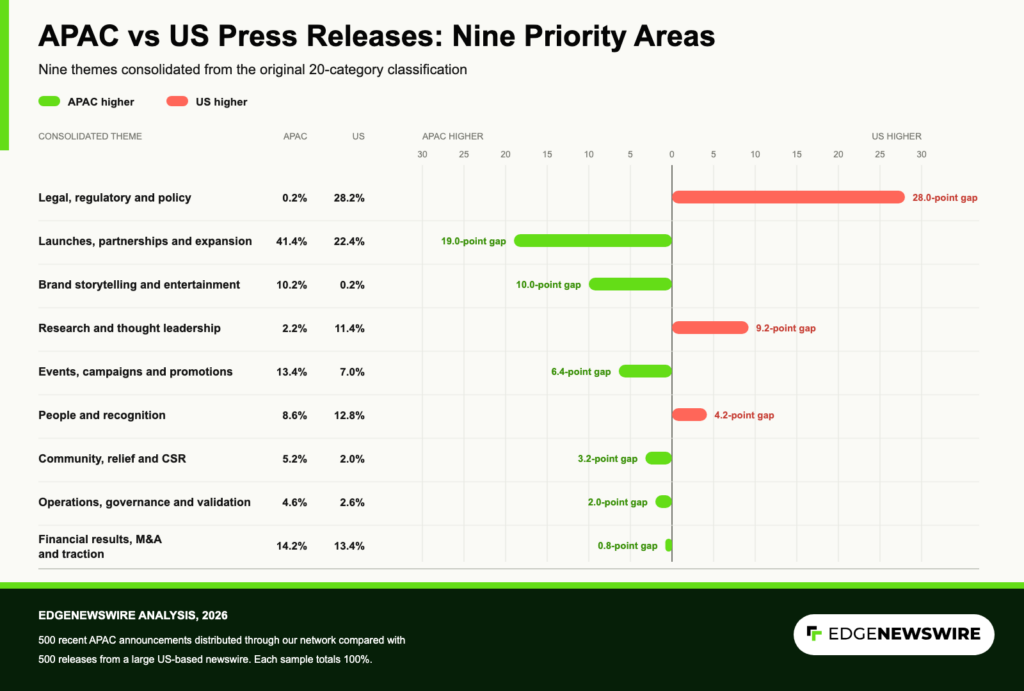
    The APAC feed is built around market activity

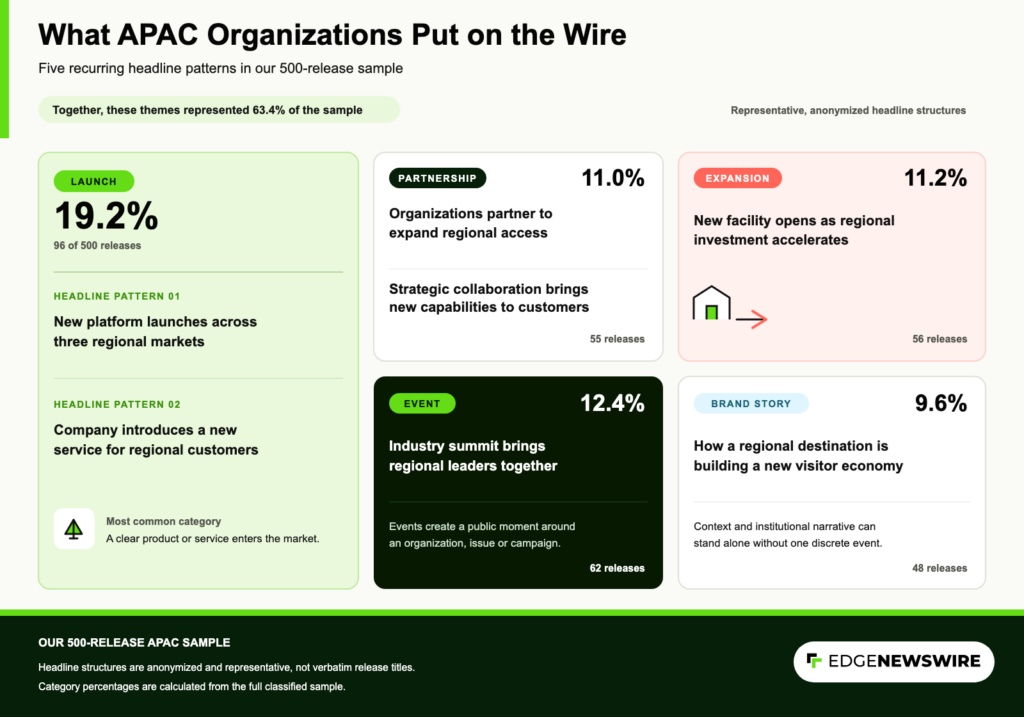
    Product and service launches were the largest category in the APAC sample, representing 19.2% of releases.

    Events and campaigns followed at 12.4%. Expansion and investment accounted for 11.2%, while partnerships represented another 11.0%.

    Together, those four categories made up 53.8% of the APAC feed. More than half of the titles therefore centered on bringing something to market, entering a market, building a relationship or creating a public moment around an organization.

    That mix gives the APAC feed a forward-looking character. Companies use the wire to show movement: a new offering, a new territory, a new collaborator, a new facility or an event intended to attract attention beyond the organization itself.

    Partnership and expansion releases are especially revealing. Combined, they represented 22.2% of the APAC sample, compared with 7.8% of the US sample. The difference is not simply that APAC companies had more corporate activity during the period. It shows how frequently collaboration and regional growth were considered worthy of a formal distributed announcement.

    Our APAC sample also contained a category that was almost absent from the US feed: brand storytelling without a discrete announcement.

    These feature-style releases described a destination, organization or broader trend without placing one specific event at the center. Titles included pieces about rural tourism, museums as cultural bridges and regional destination strategies. They read more like sponsored features or institutional narratives than conventional announcements.

    There were 48 such releases in the APAC sample, or 9.6%. The US sample contained one, representing 0.2%.

    This does not make one approach more legitimate than the other. It shows a difference in what the wire is expected to carry. Within the APAC feed, distribution is used not only to record an event but also to build context, shape perception and introduce a place or brand to audiences that may not already know it.

    For a PR firm onboarding an APAC client, this pattern helps explain the client’s instincts. The client may see a new partnership, market expansion, event or institutional story as evidence of momentum. The agency does not need to remove that context. It needs to identify the clearest consequence for the reader and make the central development unmistakable.
    The US feed is more procedural and event-specific

    The US sample looked different from the first screen of results.

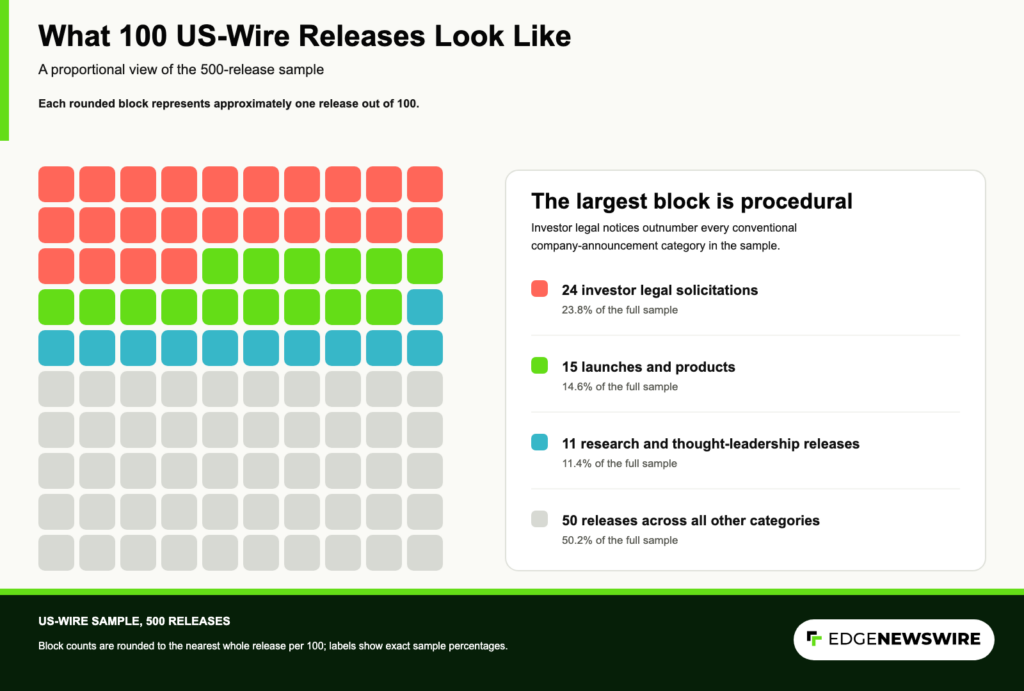
    Securities litigation solicitations were its largest category at 23.8%. The concentration was not caused by one isolated case. The feed contained repeated notices from law firms announcing investigations, reminding investors of filing deadlines and seeking shareholders affected by alleged corporate misconduct.

    These releases serve a clear function. They put a dated legal notice into a widely distributed public channel. They also change the composition of the feed. Anyone monitoring raw US-wire volume encounters a substantial layer of content that is neither company news nor independent financial reporting.

    Research and thought leadership formed another 11.4% of the US sample, compared with 2.2% in APAC. This category included market-sizing reports, consumer surveys, expert commentary and syndicated advice content.

    Unlike APAC’s feature-style brand stories, these pieces were usually anchored to a stated finding, report or expert position. They gave the release a discrete reason to exist even when no product or corporate transaction had occurred.

    The US feed also carried more appointments and awards. Those are familiar corporate communications categories: a named person enters a role, or a named organization receives a specific recognition. The common thread is a defined event with an identifiable party and a clear date.

    Launches still mattered. They represented 14.6% of the US sample and were the largest conventional company-announcement category. The difference was the surrounding material. A US release competed for attention beside legal deadlines, research findings, appointments, awards and other tightly defined events.

    For an APAC company entering the US, this feed creates a practical test. The release should answer “What happened?” quickly. A broad company story may become stronger when it is anchored to a launch date, research finding, investment, appointment, measurable result or other development that gives the headline a clear reason to exist now.
    Two communication cultures emerge

    The APAC feed often uses a release to establish context and momentum through relationships, expansion, events and institutional stories. The US feed uses it more frequently as procedural infrastructure for a deadline, finding, appointment, recognition or other defined development.

    Legal systems, issuer mix and platform practices contribute to the difference, but the practical result is clear. A release enters two different sets of expectations depending on where it is distributed.

    Where the two feeds meet

    The feeds were not different in every category.

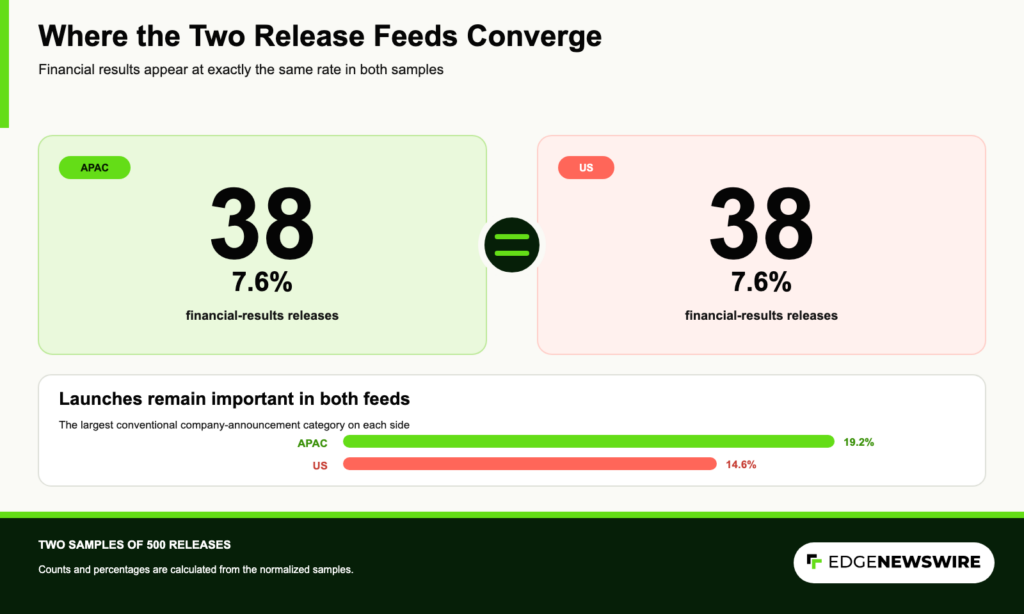
    Results and financial announcements accounted for 38 releases in each sample, representing 7.6% on both sides.

    That symmetry matters. Earnings and financial results are among the most standardized forms of corporate communication. They have a defined period, expected metrics, named reporting entity and clear reason for publication. The same basic function transfers readily between distribution environments.

    Launches were also important in both samples. They were the largest conventional company-announcement category on each side, at 19.2% in APAC and 14.6% in the US feed.

    Organizations everywhere use the wire to introduce something new and document financial performance. The larger differences appear in what each ecosystem accepts around that shared core.
    What PR firms should take home

    The data shows what organizations send, not which format earns the most attention. Its value is in helping an agency anticipate the communication environment a new release will enter.

    1. Understand the client’s native idea of news

    An APAC company may arrive with a partnership, expansion plan, event or broader brand narrative. Those are common instincts in our sample, where partnerships and expansion represented 22.2% of releases. Identify what the client is trying to prove, then decide which detail deserves the headline.

    2. Give an APAC story a sharper US news peg

    The US feed contained very little brand storytelling without an announcement. Only 0.2% of releases fell into that category, compared with 9.6% in APAC.

    An APAC company entering the US should avoid relying on atmosphere or background alone. Connect the story to a launch, new data, an appointment, an investment, a customer milestone or another dated development. Keep the regional context, but make what changed immediately clear.

    3. Give a US story enough APAC context

    A US company entering APAC can make the opposite mistake. The release may state the event clearly while assuming the audience understands why the organization, partner or product matters locally. Explain the relationship, markets involved, local problem and commitment behind the announcement without adding empty corporate language.

    4. Benchmark against the right category

    Raw volume is not a neutral measure. Legal solicitations account for nearly a quarter of the US sample, while the APAC feed includes more feature-style stories. Compare launches with launches, research with research and financial results with financial results. Otherwise, overall volume can obscure the client’s real competitive visibility.

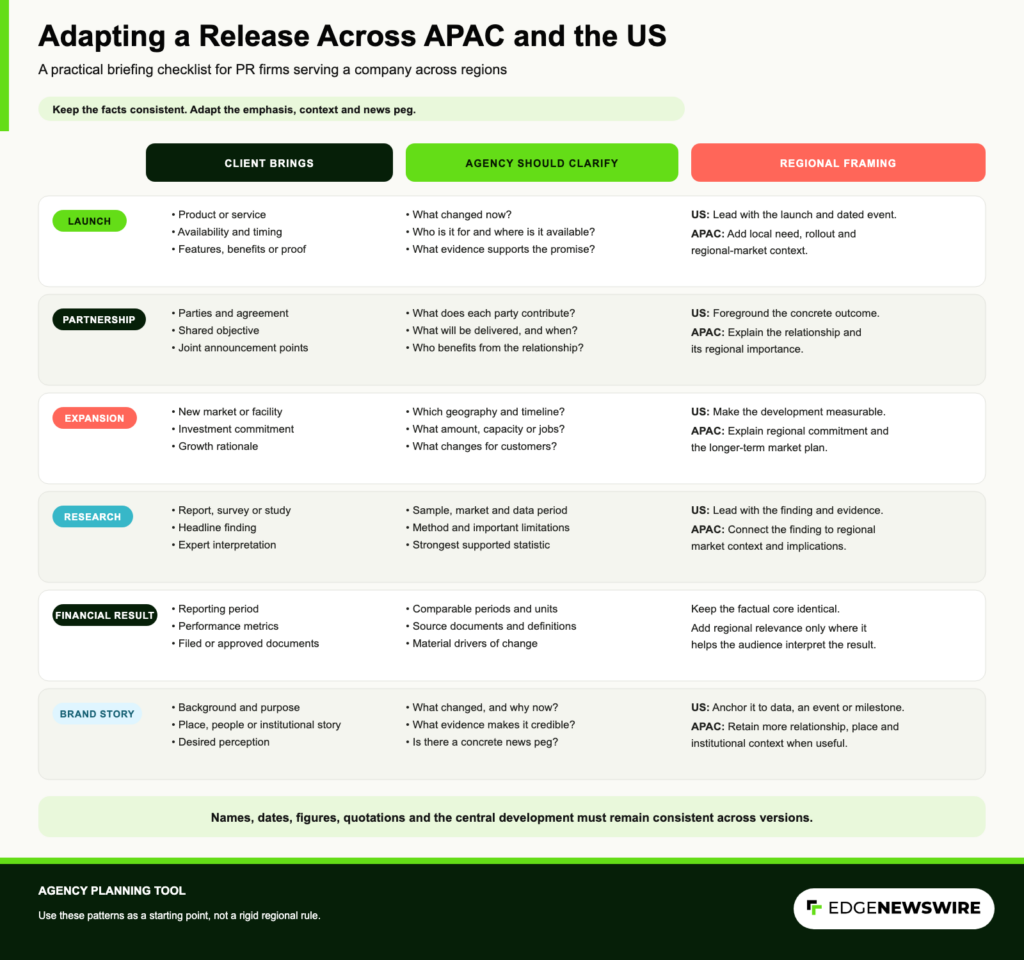
    5. Adapt the framing without changing the facts
    A wire is not just a pipe

    Press releases are often discussed as though distribution networks were interchangeable pipes carrying the same kind of material to different places.

    The latest releases in these two feeds suggest otherwise. The surrounding communication culture affects what clients consider news, what a release competes against and how an agency should frame the story.

    Our APAC sample was dominated by launches, events, expansion and partnerships, with a meaningful layer of brand storytelling. The US sample devoted nearly one-quarter of its flow to investor legal solicitations and about five times the share to research and thought leadership.

    Yet both samples contained 38 financial-results releases, and launches remained central on each side.

    The format travels. The communication culture around it changes.

  • What is Media Relations and Why is it Important?

    What is Media Relations and Why is it Important?

    Most organizations want media coverage because it gives them credibility they cannot buy.

    When a publication covers your company, nonprofit, or project, it changes how people see you. It will create that moment where readers think, “Oh, this company is legit! Independent outlets are talking about it.”

    Media coverage also puts you in front of relevant audiences because journalists build their readership around specific beats like business, tech, healthcare, or local news. When your story appears in the right place, you are more likely to reach people who are already in your target market.

    That raises two questions: what does media relations actually involve, and why is it worth the effort?

    What is Media Relations? 

    Media relations is the practice of working with journalists and editors so your news has a chance to be covered as editorial content. 

    It’s earned media, not paid advertising or sponsored posts.

    In practice, media relations usually includes:

    • Writing press releases and background materials
    • Pitching specific story angles to relevant journalists
    • Answering follow-up questions and providing context or data
    • Coordinating interviews or briefings
    • Supplying images, facts, or supporting documents

    Over time, this work builds a track record. Journalists learn which sources are reliable and which ones waste their time. That reputation matters more than most teams expect.

    Why is Media Relations Important?

    The value of media relations shows up in a few very practical ways.

    #1 It builds credibility

    When an independent outlet like USA Today, Business Insider, and AP News covers your story, it carries more weight than something you publish yourself. 

    Readers understand the difference between marketing copy and editorial judgment, even if they cannot always explain it.

    #2 It reaches the right people

    Journalists already have audiences.

    If your story appears in a publication that covers your space, you reach people who are more likely to care about the topic in the first place.

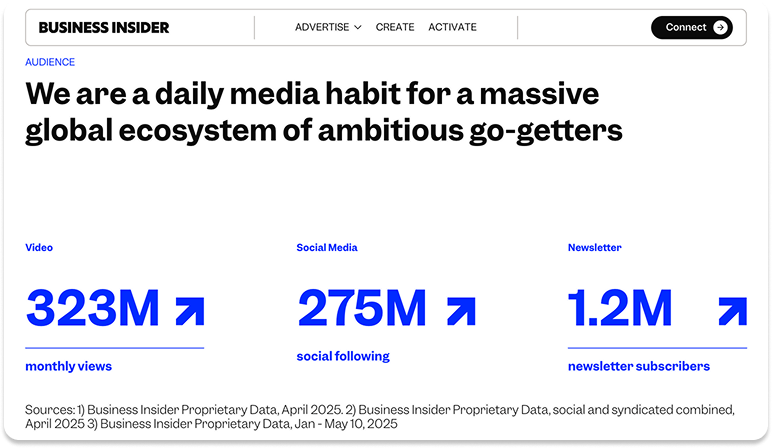
    For example, outlets like Business Insider have large, business-focused audiences:

    Business Insider audience page showing 323M monthly views, 275M social followers, and 1.2M newsletter subscribers.

    Once your release appears in a publication like Business Insider, you have a better chance of being discovered by people who already follow that space.

    #3 It keeps working over time

    Once your releases are published, they stay online and searchable. 

    For example, when AP News wrote about ‘Miss Atomic Bomb’ in June 2025, that article did not vanish even after 4 months.

    AP News article page with a story excerpt and an image of food on the right.

    It is still there, still searchable, and still discoverable by anyone looking up about it.

    #4 It delivers measurable ROI

    Media coverage works differently than paid advertising. Instead of paying for every impression, you invest in creating newsworthy content and distributing it professionally. One solid piece of coverage (especially from an industry-specific publication) can generate more qualified leads than thousands of dollars in ad spend.

    For B2B companies and niche markets where relevant audiences are expensive to reach through paid channels, this efficiency advantage is substantial.

    What You Actually Do in Media Relations

    1. Building and maintaining a media list

    A good media list is focused and current. It includes journalists who actually cover your topic.

    The reason is simple. Journalists work on specific niches. If you send a story about factory automation to someone who covers lifestyle or politics, it will be ignored. 

    A smaller, well-targeted list almost always outperforms a large, generic one.

    2. Deciding what is worth pitching

    It is important to know what is actually worth pitching, otherwise you end up wasting time on stories no one wants to cover. 

    Not every internal update is news. 

    A simple test can help you to decide: would someone outside your company care about this if your logo were removed from the story? If the answer is no, it probably needs a different angle or more substance.

    3. Preparing spokespeople

    A spokesperson is the person who represents your organization when talking to the media. This role matters because journalists will often rely on that person’s words to shape the entire story. 

    If they are unclear, careless, or overly promotional, it shows up in the coverage.

    For that reason, you need to prepare your spokespeople that can explain things clearly and correctly, instead of persuading. 

    They should know what they can say, what they should avoid, and how to communicate in plain language without turning answers into a pitch.

    Otherwise, you can end up in the kind of situation where an executive’s response becomes the headline and extends the controversy instead of calming it.

    A well-known example is the United Airlines incident, where Oscar Munoz, then CEO of United, made early statements that focused on defending internal procedures and blaming the passenger. 

    Article headline reading “United Airlines CEO: Passenger Removed From Flight Was ‘Disruptive and Belligerent"

    Even if some details were accurate, the tone came across as defensive and out of touch with what people had seen in the videos, which made the backlash worse, not better.

    4. Creating usable materials

    Press releases, fact sheets, backgrounders, and images exist to make a journalist’s job easier. So you need to prepare good materials for them. 

    If a journalist cannot quickly find the key details they need, they are less likely to use your story.

    In practice, “basic information” usually means things like:

    • What is the news?
    • Who is involved?
    • When did it happen?
    • Why does it matter?
    • How does it work?
    • Who can I contact for follow-up?
    • Where are the images or supporting materials?

    Journalists work under time pressure. If they open your release or media kit and have to hunt for these answers, they may just move on to the next story.

    5. Pitching stories

    A pitch should be short and specific. It should explain why the story fits that reporter and why it matters now. 

    For that reason, you should avoid sending the same message to every journalist on your list. 

    A targeted pitch shows that you understand the reporter’s work and that you are offering something relevant, not just broadcasting an announcement and hoping someone picks it up.

    6. Coordinating interviews and briefings

    Some stories need more input from the people involved. To make that happen, you need to coordinate scheduling, preparation, and follow-up so you can get the right people involved. 

    Those people can then provide the accurate and useful information the journalist needs.

    7. Tracking coverage

    You should know what gets published, where, and how it is framed. This is important to help your organization understand what is actually working and what is not. 

    Looking at the coverage shows you which stories resonate, which angles fall flat, and where your messaging gets misunderstood or ignored. 

    Without this feedback, you are just guessing and likely to repeat the same mistakes.

    8. Maintaining relationships

    This mostly comes down to being useful, honest, and responsive. 

    Journalists remember who wastes their time. They also remember who makes their work easier.

    These mechanics of media relations are necessary, but they are not the whole picture. Without a clear strategy, even good execution turns into scattered effort. 

    The next step is to look at how to shape these activities into a coherent media relations strategy.

    Best Practices for Effective Media Relations

    Without a clear strategy, media relations often fail, even when the tools are in place. That is why strategy is one of the most important parts of doing media relations well.

    #1 Start with relevance

    Define who you want to reach and where they get information. Build your media list around that.

    Do not start with outlet rankings or logo collections.

    #2 Set simple goals

    You need goals because they give your media relations work direction. Without them, it is hard to decide what to pitch, who to pitch to, or whether your effort is paying off.

    But the goals also need to be the right kind. 

    For instance, “More coverage” is not very useful because it is vague and hard to measure. It does not tell you which outlets matter or what kind of stories you should focus on. 

    A simple goal like “coverage in these three industry publications around this topic” is clearer and easier to evaluate. If you cannot tell whether you succeeded, you cannot learn or improve.

    #3 Plan your story pipeline

    Looking ahead helps you avoid treating every announcement as a last-minute scramble. Product updates, data releases, customer stories, and industry commentary usually do not come out of nowhere. 

    If you plan them in advance, you have time to shape better angles, gather useful details, and line up the right spokespeople.

    When everything is done at the last minute, most stories end up sounding generic. They focus on what happened, but not why it matters, and they are much harder for journalists to use.

    #4 Focus on stories

    “Company does X” is rarely enough on its own. That is just a statement of fact, and it gives a journalist very little to work with. 

    What makes something worth covering is usually context, timing, or impact.

    “Here is why X matters now” works better because it explains why the news is relevant to people outside your company. 

    It gives the story a reason to exist today and makes it more useful to a reader, not just to you.

    #5 Be realistic about timing

    Major news events, industry conferences, and reporting schedules all affect what gets covered.

    You cannot control those things, but you can avoid launching your story when everyone is focused on something bigger and more urgent.

    #6 Review outcomes

    It is easy to confuse activity with results. Sending ten pitches only tells you that work was done. It does not tell you whether the work was effective. 

    Outcomes are things like getting a reply, having a meaningful conversation with a journalist, or securing a piece of coverage. 

    Reviewing these outcomes helps you see what is working, what is not, and where you need to adjust your approach.

    Even with a simple strategy like this, many teams still struggle with media relations. Most problems do not come from a lack of tools or effort. They come from repeating a small set of common mistakes.

    Common Mistakes in Media Relations

    Some patterns show up again and again.

    • Spray and pray: Sending the same pitch to everyone on your media list shows you haven’t done the work to understand what each journalist actually covers. Targeted pitches get responses. Generic blasts get ignored.
    • Treating updates as news: Minor feature releases, small client wins, or internal promotions usually aren’t newsworthy on their own. They need bigger context or a compelling angle to matter to people outside your company.
    • Overloading press releases: Trying to announce three different things in one release dilutes all of them. Pick the most newsworthy angle and lead with that.
    • Chasing logos over relevance: Coverage in TechCrunch sounds impressive, but if your target market doesn’t read TechCrunch, it’s not helping you. Focus on outlets your audience actually follows.

    These mistakes share a common root: confusing visibility with value. More pitches, bigger outlets, and wider distribution don’t matter if the underlying story isn’t relevant to the journalists you’re pitching or the audiences you need to reach.

    Final Takeaway

    Effective media relations is about having something worth covering, sending it to the right people, and making it easy for your story to be understood and picked up.

    Press releases and distribution platforms like EdgeNewswire play a key role in making that happen. 

    They help you scale your reach, increase visibility, and put your news in front of the audiences and outlets that matter. 

    When paired with a clear story and smart positioning, distribution becomes a powerful way to amplify your message, not just a delivery mechanism.

    The strongest results come from combining relevance, relationships, and reach. When those work together, you give your story the best chance to earn coverage that actually makes an impact.

    Frequently Asked Questions (FAQs)

    Q: What is media relations?

    A: Media relations is working with journalists to earn editorial coverage. It includes press releases, pitching stories, arranging interviews, and providing supporting materials.

    Q: How is media relations different from advertising?

    A: Media relations earns unpaid editorial coverage, while advertising is paid placement. Editorial coverage tends to carry more credibility because it’s independently chosen.

    Q: How do I know if a story is worth pitching?

    A: Remove your logo and ask if an outsider would care. If not, the story likely needs a stronger angle or more substance.

    Q: What are the most common mistakes in media relations?

    A: Common mistakes include mass pitching, treating minor updates as news, cramming multiple announcements into one release, and targeting big outlets instead of relevant ones.

    Q: How should I build a media list?

    A: Keep it focused and up to date, targeting journalists in your niche. A smaller, relevant list usually performs better than a broad one.